You step off the curb in Seoul, arm half-raised, and three empty taxis sail past without slowing. In Korea most taxis are called through an app, not flagged down — and the app everyone uses is Kakao T. It has a full English mode, it works with your home phone number, and once it’s set up you can get a taxi almost anywhere in the country without speaking a word of Korean. Here’s exactly how.
The short version
Download Kakao T before you fly and sign up with your home number. When you need a ride, set your destination, pick a taxi type (General is cheapest; Blue is Kakao’s guaranteed-dispatch option), and tap to call. The app matches you with a nearby licensed taxi, shows the car and the route, and you pay by a card saved in the app — or hand the driver cash or a T-money card at the end.
Do you actually need Kakao T?
Korea barely uses street hailing anymore — especially late at night and outside the busiest districts. Kakao T is how locals get taxis, and it fixes the two things that make taxis stressful abroad: you don’t have to say your destination (you set it on the map), and you’re not guessing the fare (it’s metered, with an estimate up front). The same app also covers buses, trains, and the AREX airport express.
Set it up before you fly
Do this at home, on your own Wi-Fi, before the trip — not at 1 a.m. at Incheon.
- Download Kakao T (App Store / Google Play) and open it.
- Sign up with your home phone number — you do not need a Korean number. It sends a one-time SMS code to verify.
- If it opens in Korean, switch it to English in the settings.
One catch: verifying a foreign number can occasionally take up to a day, and the SMS code arrives more reliably on your home carrier than on a roaming eSIM. So set it up in advance, while your home SIM is still getting texts. (For the data the app runs on once you land, see our Korea eSIM guide.)
How to call a taxi, step by step
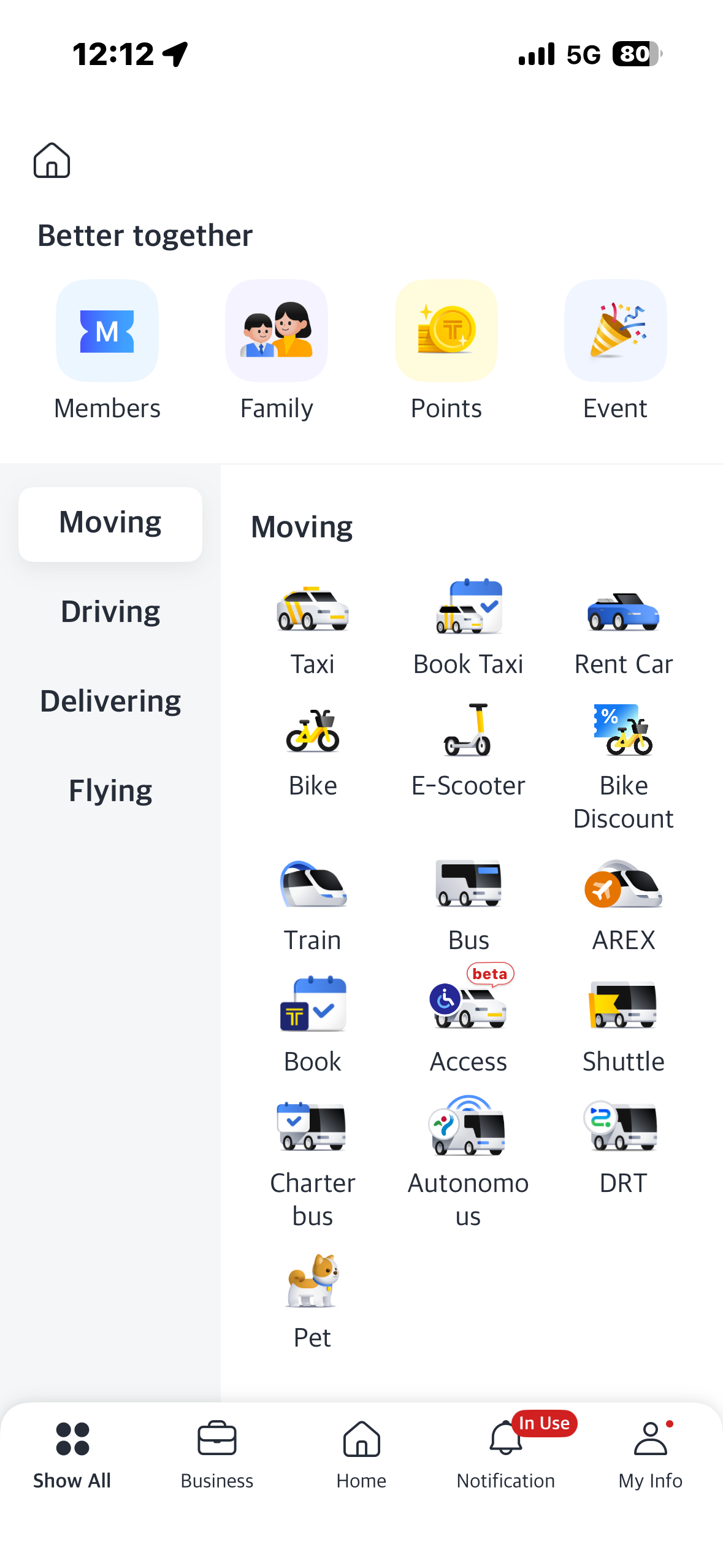
Open Kakao T and tap Taxi (or “Show All” to see everything it does).
- Set your destination on the map or by searching — English search works.
- The app shows your ride options and an estimated fare.
- Choose a taxi type and tap to call.
- It finds a nearby driver and shows the car, plate, and arrival time.
- Get in, ride, and pay.
Which taxi type should you pick?
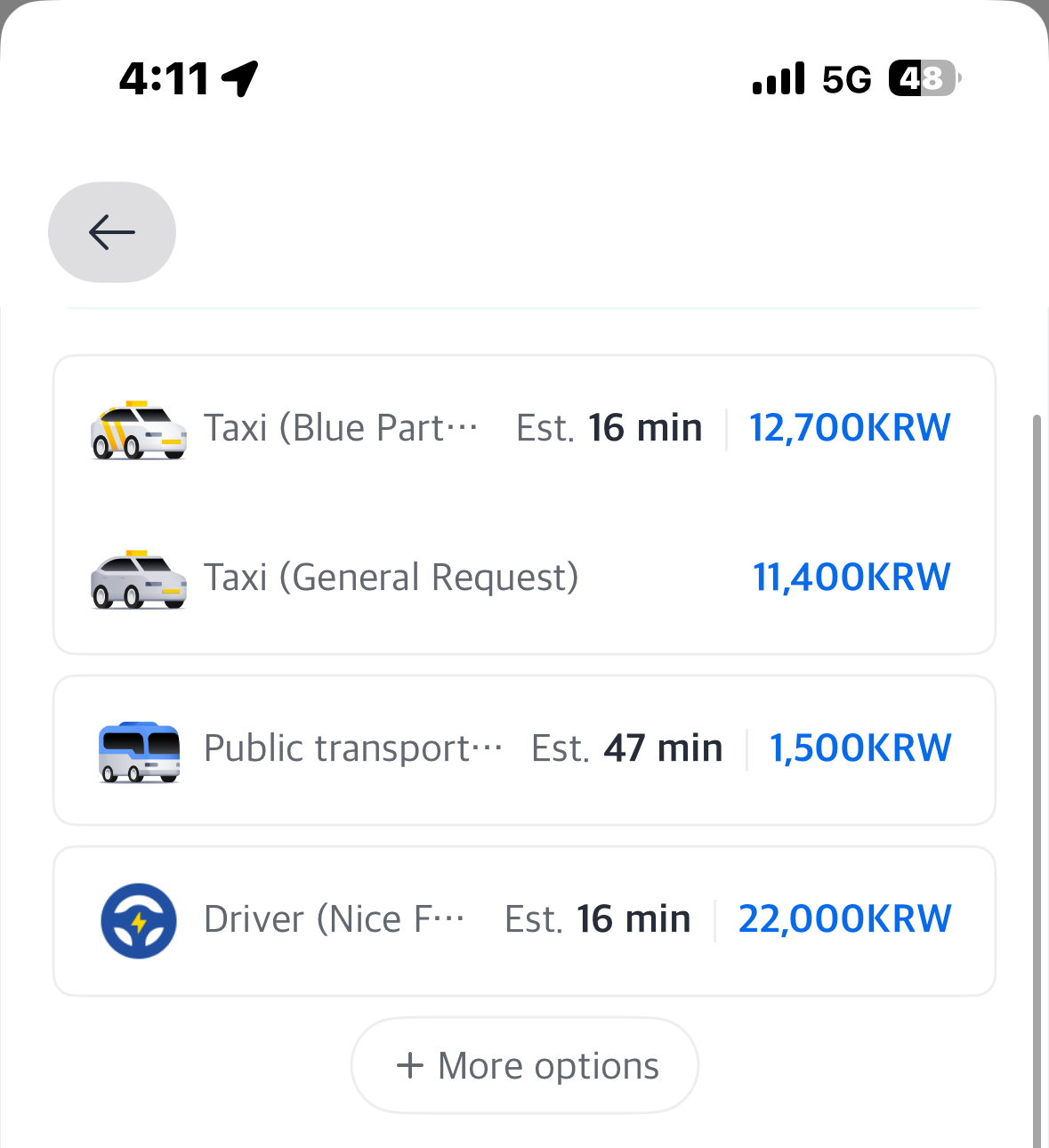
For most trips it comes down to General vs Blue:
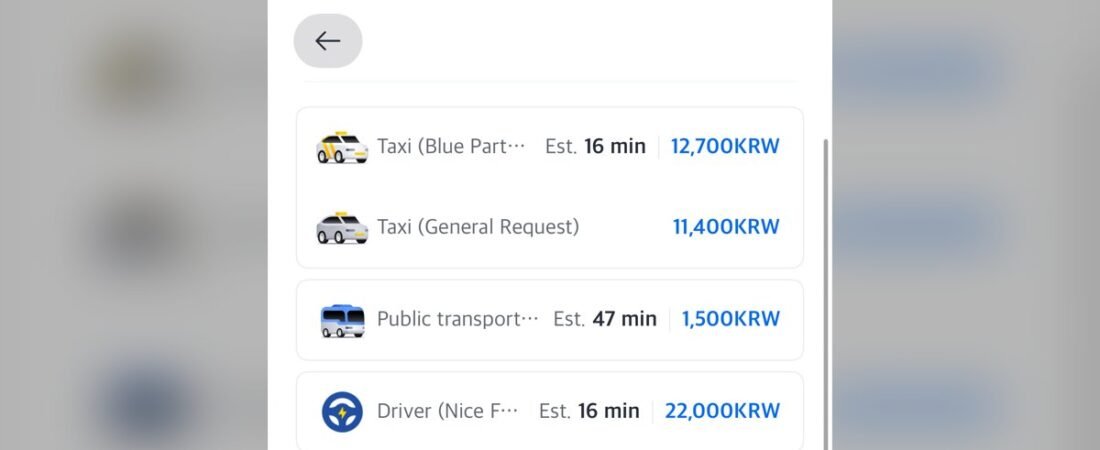
- General (일반 호출) — hails any available licensed taxi nearby. Cheapest, standard metered rate. Can be slower to match at peak times or in the rain.
- Blue (블루) — Kakao’s own branded taxis with guaranteed dispatch and a small call fee. Pricier but far more reliable when you need a car to actually show up.
- Model / premium — larger or higher-end cars for a higher fare.
- The same screen can also book a designated driver or route you by bus and subway — those aren’t taxis.
On a recent short ride the app quoted about ₩11,400 for a General taxi and ₩12,700 for Blue. The Blue premium is usually small, and it’s worth it late at night when General taxis are slow to match.
Meeting your driver and the ride
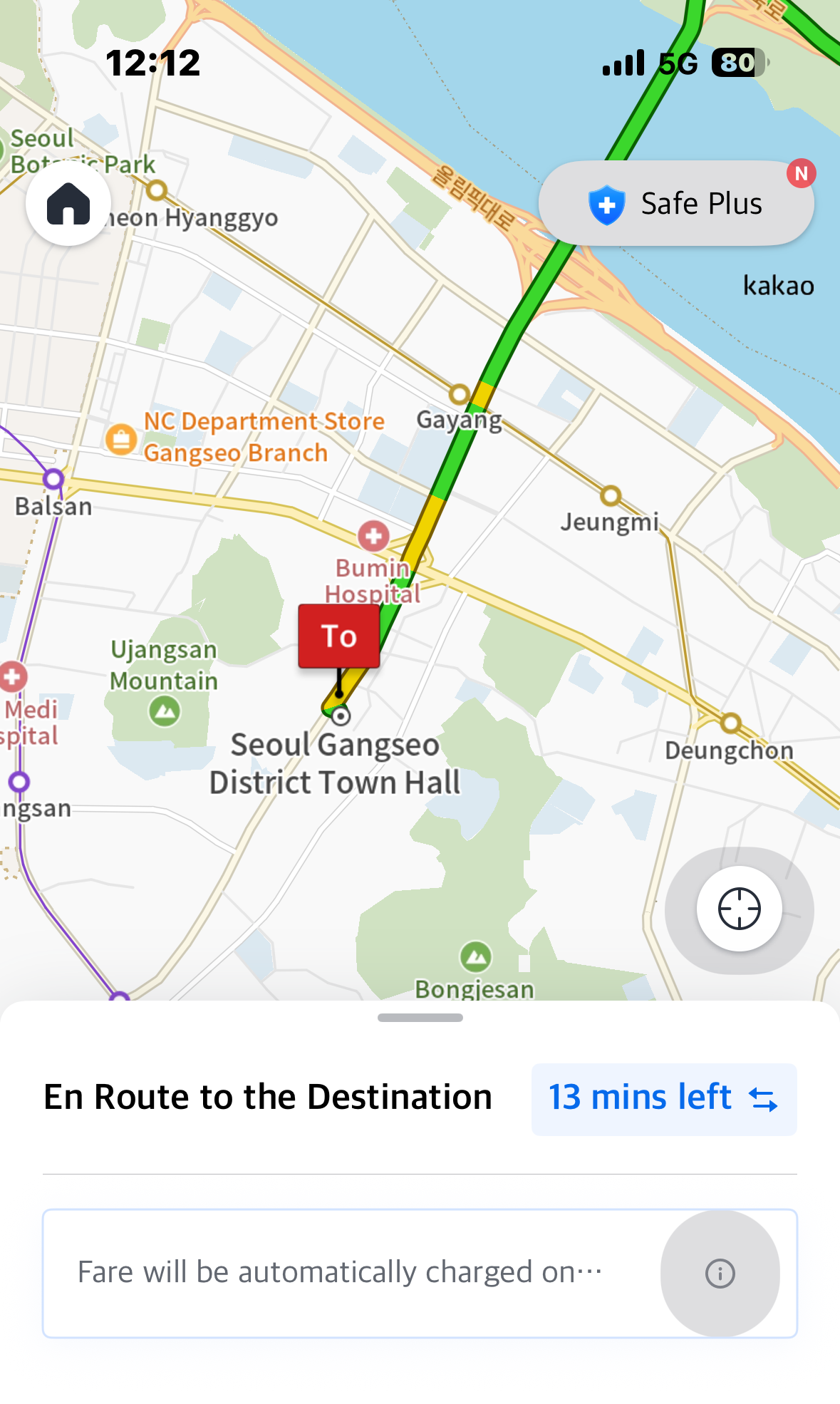
Once matched, you’ll see your taxi’s car and plate, plus a Call Driver button (handy if you’re hard to spot). There’s also Share My Location, which sends your live trip to a friend — a nice safety touch if you’re riding alone.
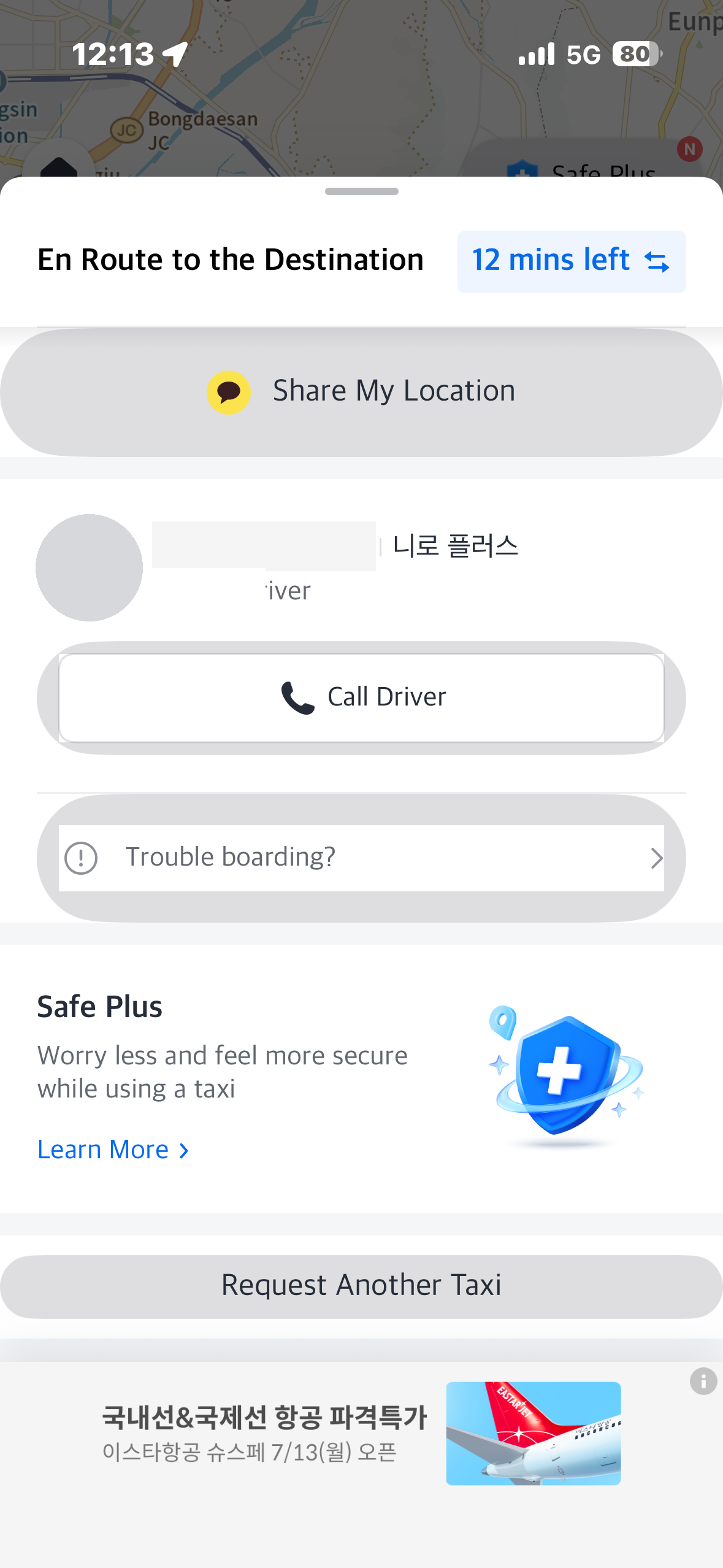
During the ride the app tracks your route and time to the destination, so you can tell you’re heading the right way even when you can’t read the road signs.
Paying: card, cash, or T-money
You have three ways to pay, and it’s worth knowing all three because foreign cards are hit-or-miss:
- A card saved in the app (easiest) — add a card and the fare is charged automatically at the end. You just get out.
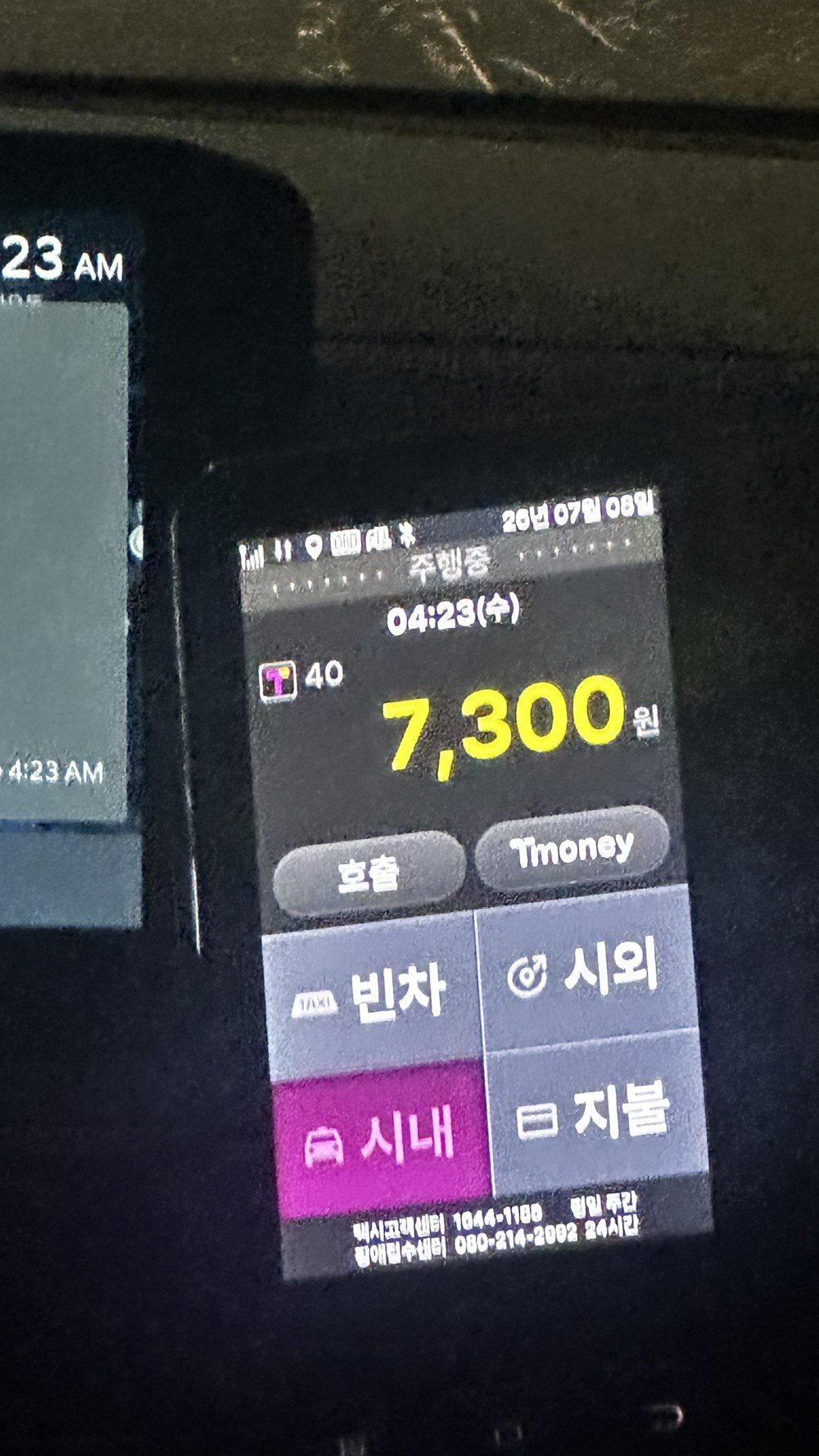
- Cash or T-money to the driver — if your foreign card won’t register (common; Kakao’s payment is built for Korean cards), pay the driver directly. Every taxi takes cash, and most take a T-money card tapped on the meter reader.
- The meter is the price — the fare you owe is the number on the in-car meter. There is no tipping in Korea.
Try to save a card at home, but don’t stress if it fails — some cash or a loaded T-money card is the reliable backup.
No Korean phone number? No problem
This is the question everyone asks: no, you don’t need a Korean phone number to use Kakao T. You sign up with your home number and a one-time SMS code, and after that the app runs on your data (your travel eSIM is fine). The only reason you’d need a Korean number is if you can’t receive that first verification text — which is why you set the app up at home, before you travel.
When Kakao T can’t find a car: Uber as backup
Occasionally — in quieter areas or at odd hours — Kakao T struggles to match a taxi. Uber also works in Seoul as a backup: in Korea it dispatches licensed taxis (branded “UT”), and it takes a foreign card you’ve already saved. Coverage is thinner and it’s usually a little pricier, so keep it as plan B.
Mistakes to avoid
- Waiting until you land to set it up. Verify your number at home; don’t fight airport Wi-Fi at midnight.
- Assuming you can flag taxis on the street. Sometimes you can, but the app is faster and removes the language barrier.
- Panicking when your card won’t register. It’s common — just pay with cash or T-money.
- Tipping. Not a thing in Korea. The meter is the fare.
FAQ
Do I need a Korean phone number for Kakao T?
No. Sign up with your home number and a one-time SMS code, ideally before you fly. After that it runs on your data with no Korean number needed.
Is Kakao T available in English?
Yes — it has a full English mode. Switch the language in settings if it opens in Korean.
How do I pay if my foreign card won’t register?
Pay the driver at the end with cash or a T-money card. Every taxi takes cash; most take T-money tapped on the meter reader.
Is Kakao T cheaper than a street taxi?
A General taxi is the same metered rate as one you’d flag down. Blue adds a small call fee for guaranteed dispatch.
Can I use Kakao T from Incheon Airport?
You can, but for the airport-to-city trip it’s worth comparing the AREX train and airport buses first — they’re often cheaper and just as easy.
Read next: get around the city with Naver Map — and before you book that airport taxi, compare it against the AREX train from Hongdae.