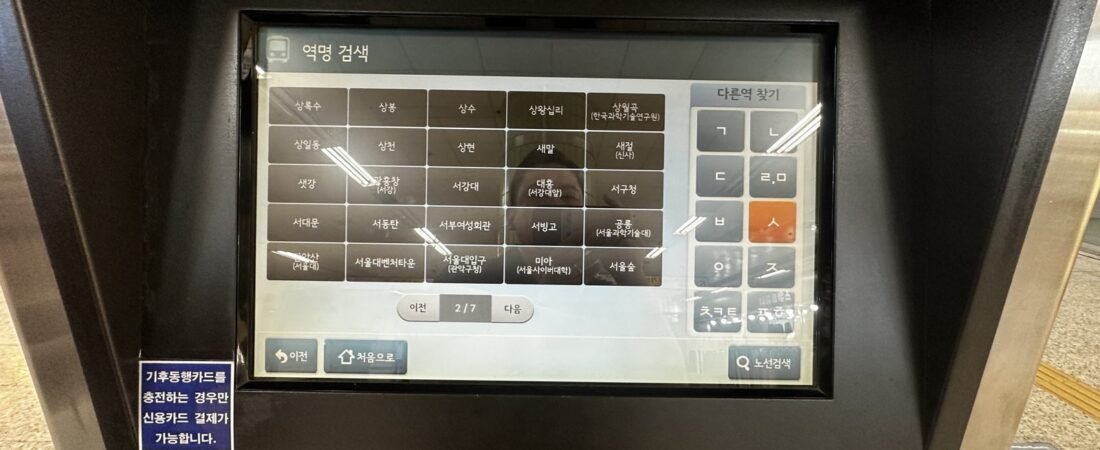
You walk up to a subway gate in Seoul, tap your credit card the way you would in London or Singapore — and nothing happens. The gate stays shut. Behind you, everyone else just touches a small plastic card to the reader and walks straight through.
That card is T-money, and in Korea it isn’t optional. It’s how you actually get on the bus and subway. Your foreign Visa or Mastercard — even in Apple Pay — won’t tap the gate here (with one tiny exception we’ll get to). So the first practical thing to sort out when you land is getting a T-money card and putting some cash on it.
Short answer: grab the Tmoney Travel Card (₩4,000) at any convenience store or the airport bus-ticket desk — nationwide buses, subway, taxis, convenience stores, done. Pay ₩2,000 more for the Travel Card+ if you want it to double as a spending card, and if you’re staying inside Seoul and riding all day, check the Climate Card instead. The full comparison is below.
What T-money actually is
T-money is Korea’s rechargeable transit card. You load money onto it, then tap it on a reader to pay — on subways, city buses, most taxis, and even for small things at convenience stores. It works nationwide: the same card rides the subway in Seoul, the buses in Busan, and the metro in Daegu or Incheon.
Two things that surprise people: it’s completely anonymous (no ID, no registration, no app needed — you just buy it and use it), and the card itself is not connected to your bank card. T-money holds its own cash balance, and you top that balance up separately.
One reason it’s close to essential: Koreans often don’t even carry a separate card — their regular bank cards have a transit function built in — but as a foreigner, a dedicated T-money is the simplest route. You can ride the subway just once on a single-journey ticket from a station machine (with a small refundable deposit), but for anything more it’s far less hassle to carry T-money. And with more and more city buses going cashless, a loaded card is fast becoming a must rather than a nice-to-have.
Where to buy one
Any convenience store sells T-money cards, and they’re on practically every corner: GS25, CU, 7-Eleven, and Emart24. Just say “T-money, please,” point at the card display by the counter, and pay in cash. You can also buy them from machines and information desks inside subway stations, and at shops in Incheon Airport.
- Price: about ₩2,500–4,000 for a plain card (cute character editions cost a bit more).
- Important: that card price is not refundable — you’re buying the card, not paying a deposit. Only the balance you load comes back later.
- Airport gotcha: the CU inside Incheon Terminal 1 has been known to stock only Cashbee (a near-identical rival card) instead of T-money. If you specifically want T-money there, try the 7-Eleven or GS25. Honestly, it barely matters which you get: Korea runs one shared system, so T-money, Cashbee, and eZL (eZL is Cashbee’s newer name) all tap the very same gates, buses, and taxis nationwide. T-money has the widest reach, especially in Seoul; Cashbee and eZL are popular in Busan. End up with one instead of another and you’ve lost nothing.
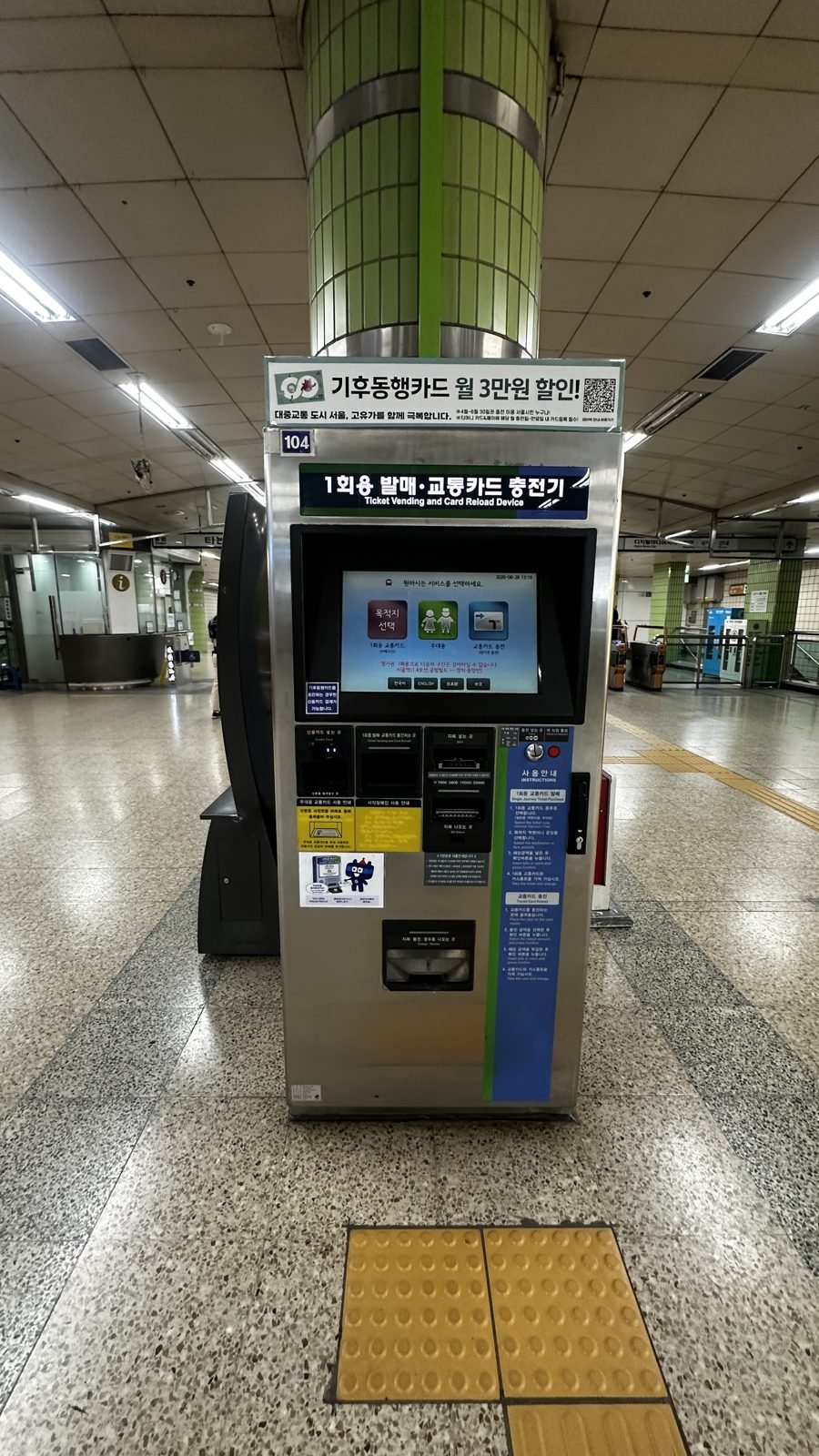
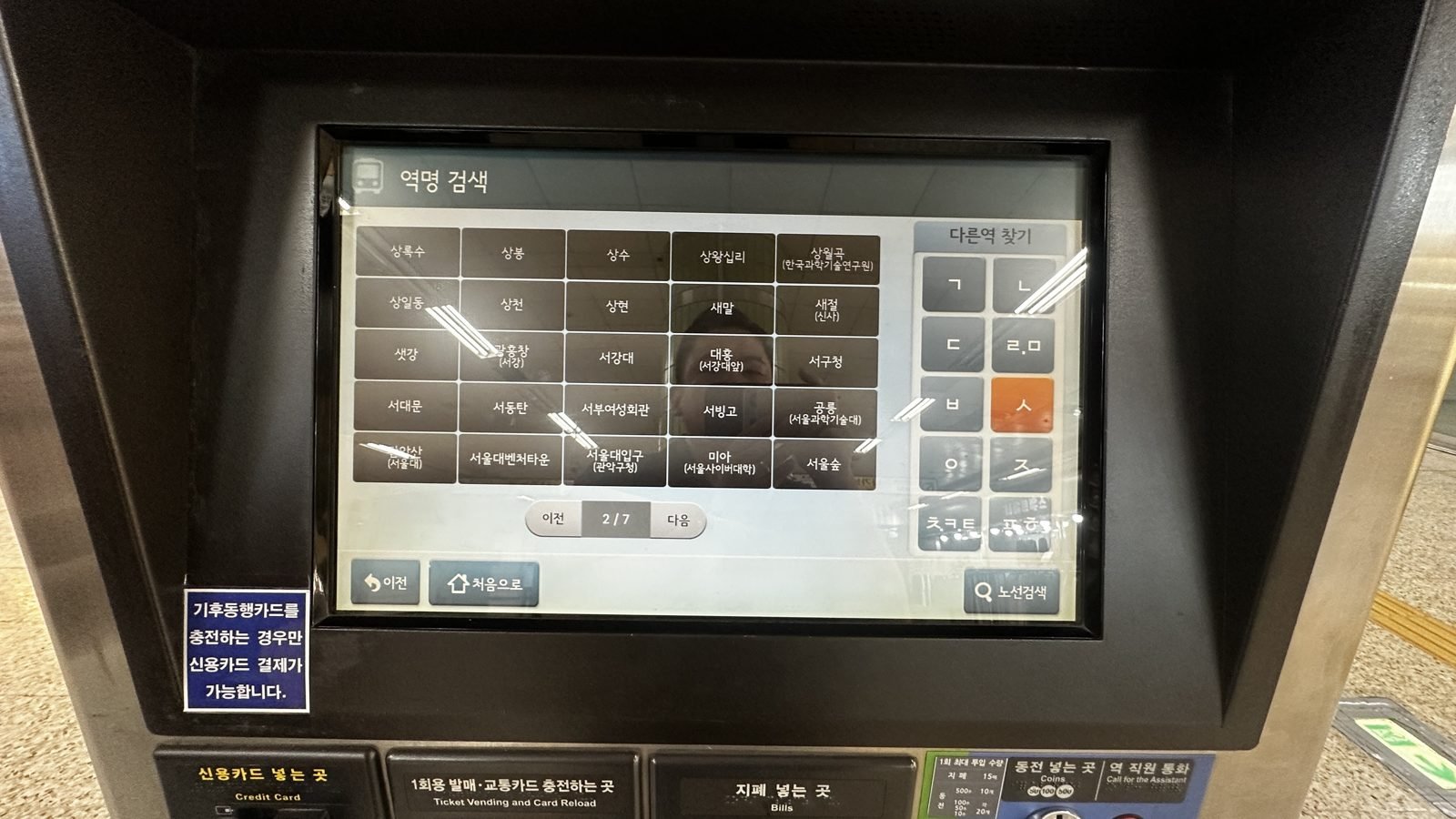
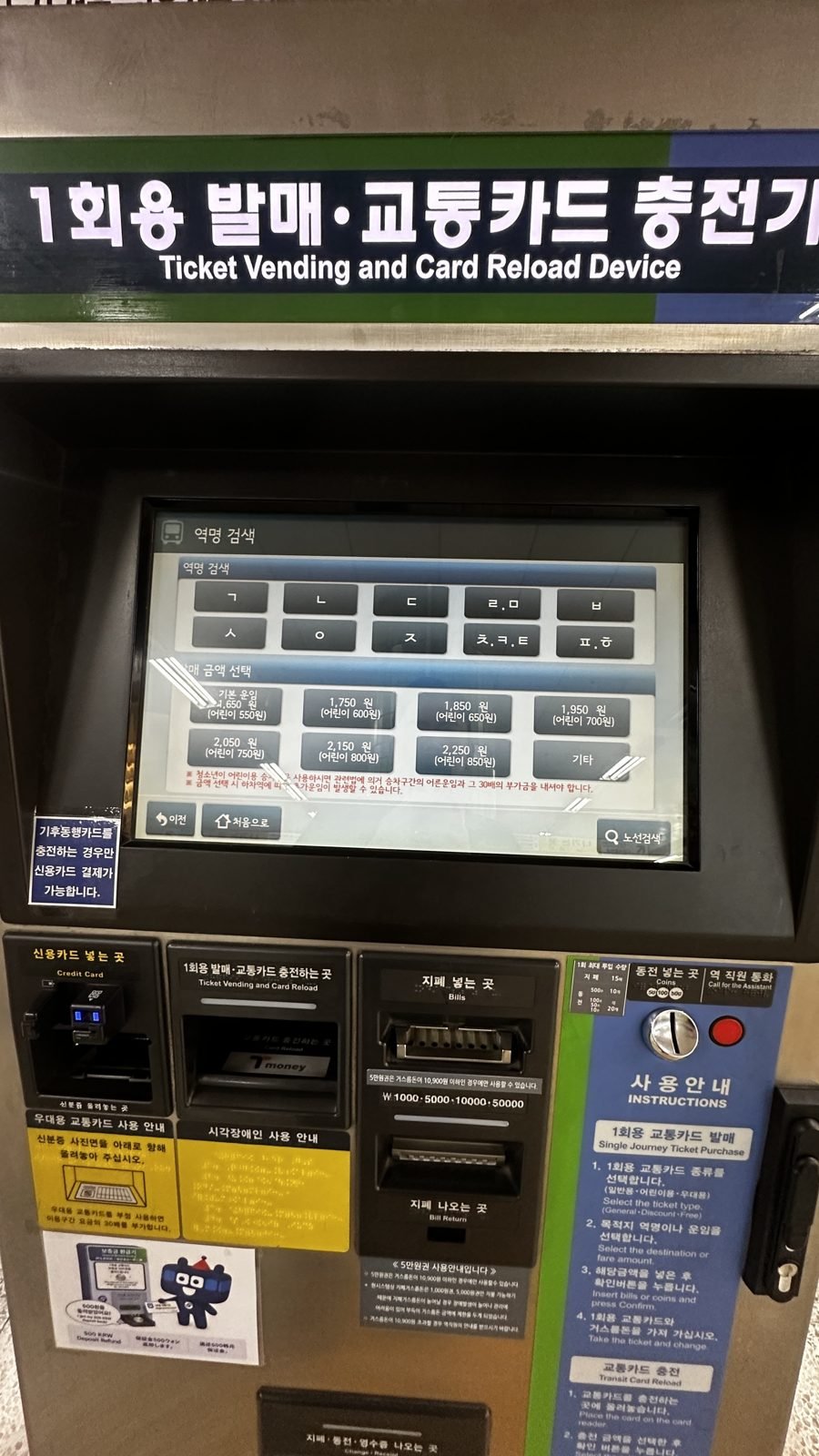
How to recharge it — and the cash trap
This is the single most important thing to know, because it catches almost every visitor:
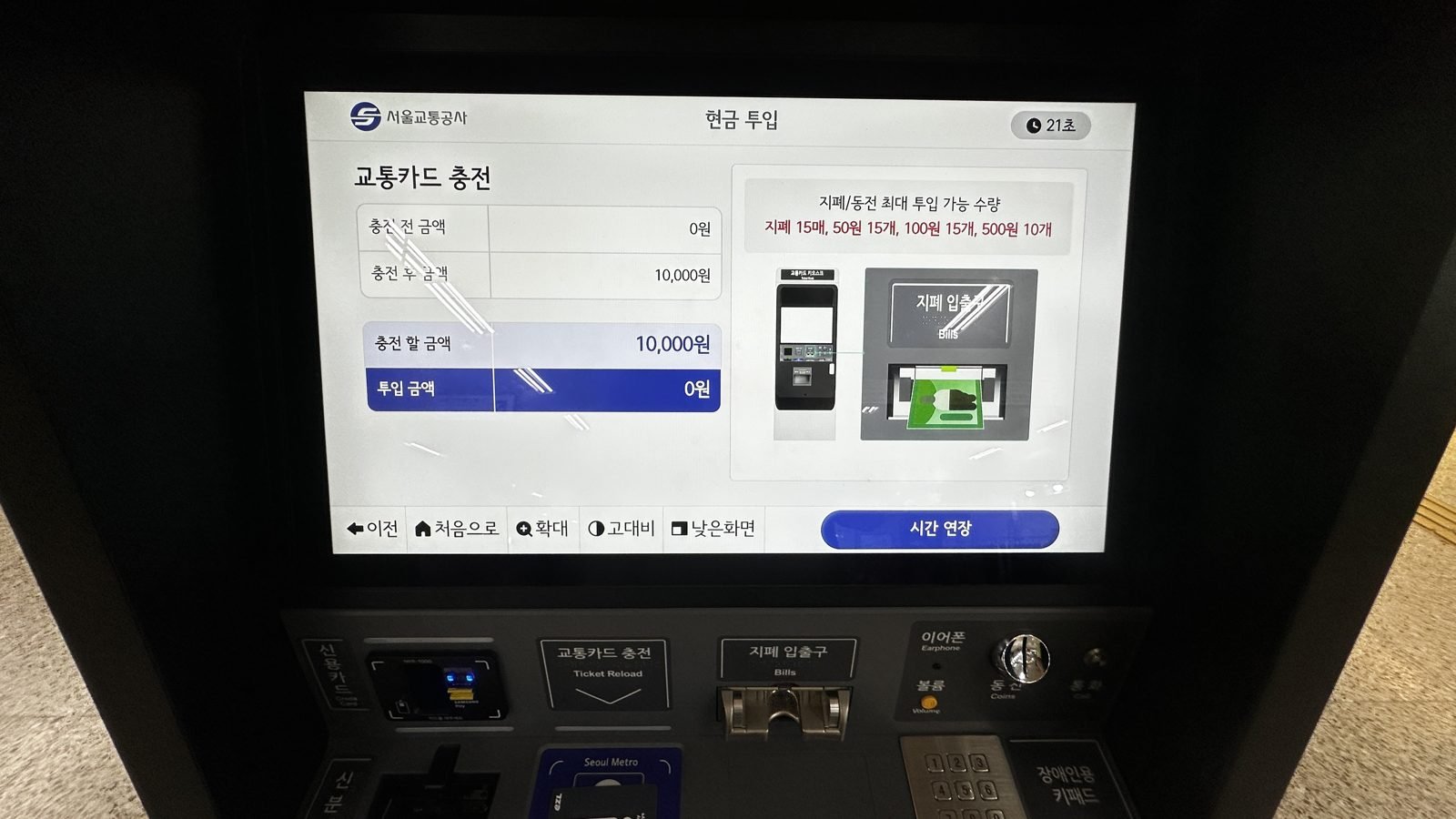
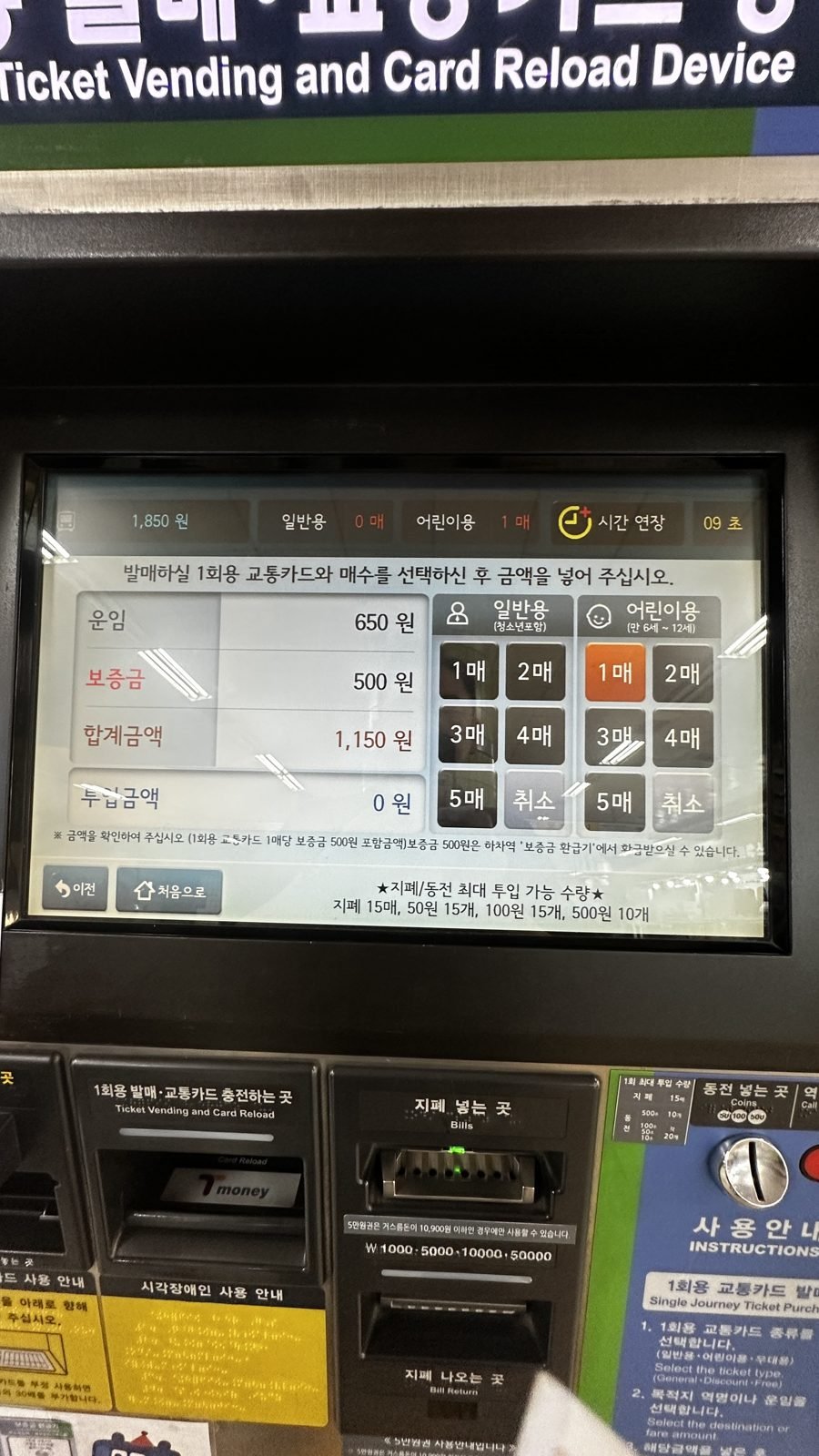
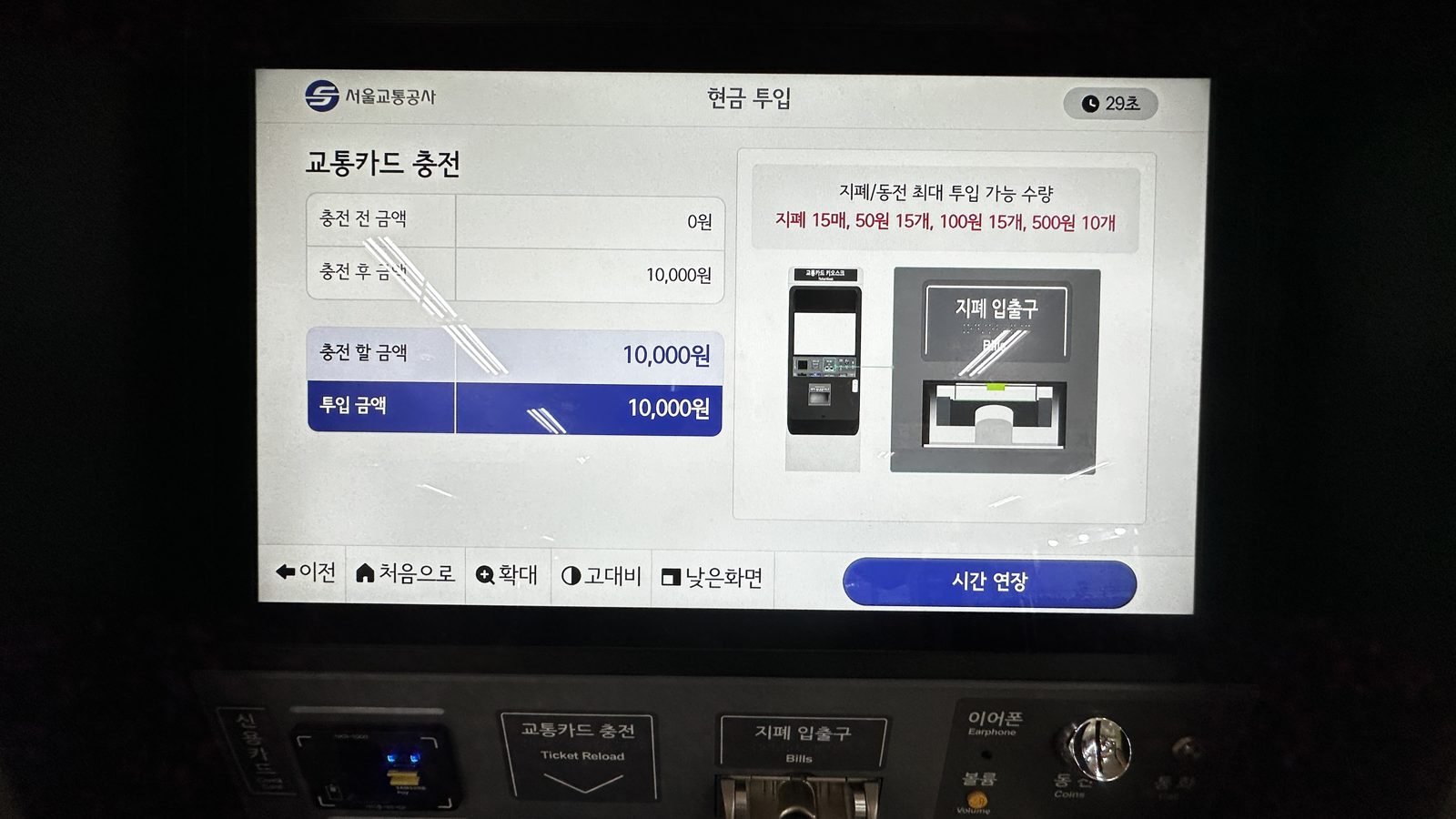
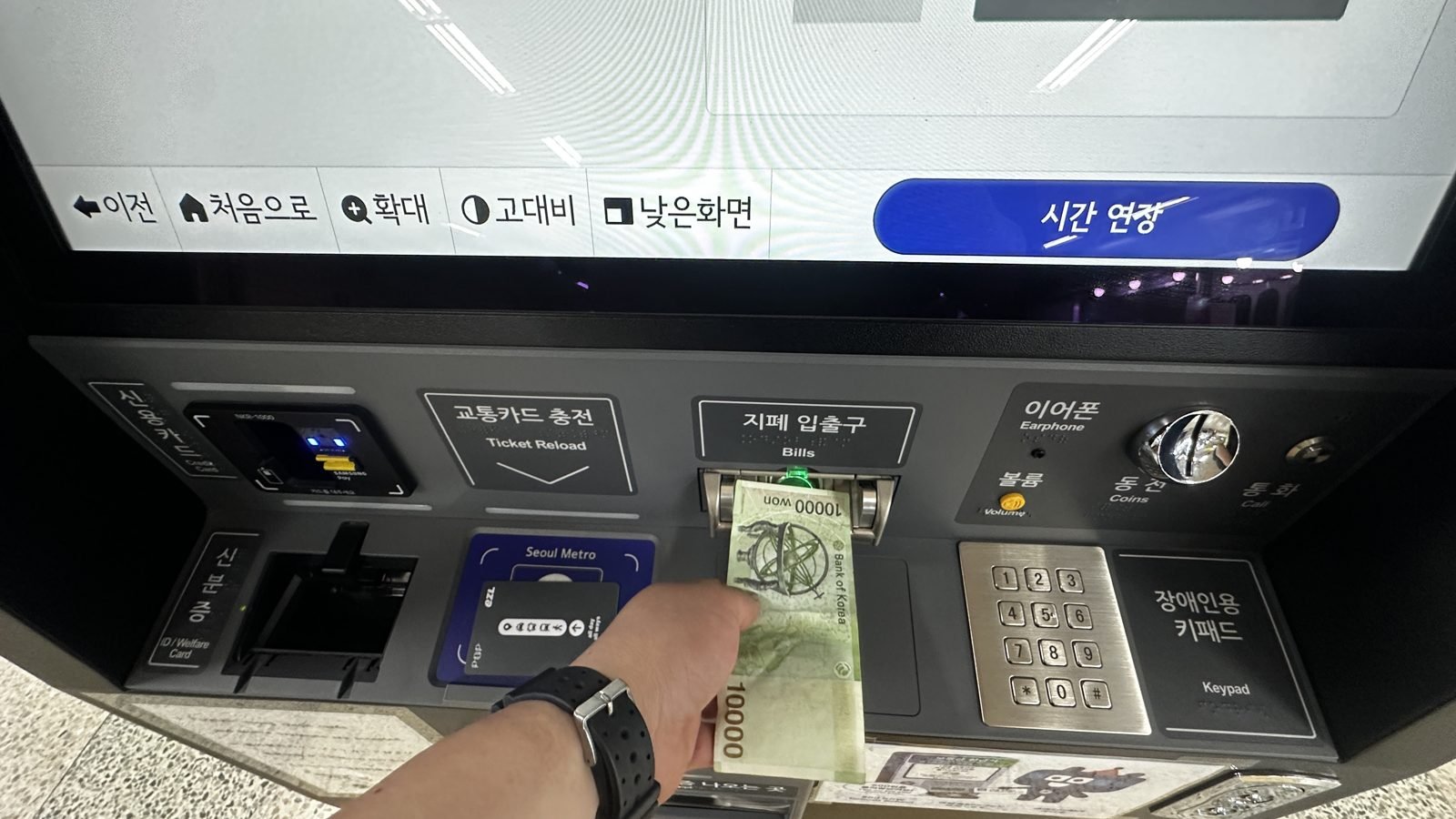
You recharge T-money with cash. Foreign credit and debit cards do not work to top it up.
At a convenience store, hand the cashier your card and some cash and say “chungjeon” (충전, “charge”) or just “top up, please.” At subway stations, the recharge machines are mostly cash-only too, though they have an English menu. So the rule is simple: carry Korean won in cash for transit, even if you pay for everything else by card.
A few limits: you can hold up to ₩500,000 on a card, and add up to ₩90,000 at a time. Most people just load ₩10,000–30,000 and top up as they go.
Where it works — the whole country, not just Seoul
A common myth is that T-money is a Seoul-only thing and you need a different card elsewhere. Not true. Thanks to a nationwide-compatible card standard, a single T-money rides:
- Every subway system in Korea — Seoul, Incheon, Busan, Daegu, Daejeon, and Gwangju.
- City buses everywhere, including Ulsan and Sejong (which have buses but no subway), and even most small rural and county buses out in the provinces.
- Jeju Island — city, airport, and village buses all take T-money.
- Most taxis (look for the sticker), and small purchases at convenience stores, some cafes, and vending machines.
So you can buy a card in Seoul and tap it on a bus in Busan or a village bus on Jeju without a second thought.
What it does NOT cover — keep a little cash for these:
- KTX and other trains, and intercity/express buses between cities — these are ticketed, not tap-to-ride, so book a ticket instead.
- Ferries to and between islands — passenger ferries aren’t part of the transit-card system. Buy the ticket at the terminal, and bring your passport, since ferries record their passengers.
- A handful of very remote counties and small islands still run cash-only buses (parts of the far Yellow Sea islands, Ulleungdo, Jindo). Unless your trip goes deep into the countryside you’ll likely never meet one, but carry a bit of cash just in case.
Paying for taxis with T-money
Yes — in a taxi you tap T-money on the in-car terminal (the same one that reads credit cards) at the end of the ride. Just keep enough balance loaded: a prepaid card can’t go below zero, so the payment fails if your balance won’t cover the fare.
It’s reliable in city taxis across the country, but not a sure thing everywhere. Some deluxe (black) and jumbo taxis, and many small-town and rural taxis, either take only a credit card (not a prepaid transit card) or are cash-only. So carry a credit card and some cash as backup — especially outside the big cities, in the Jeju countryside, and late at night.
Calling a taxi on Kakao T? You don’t need a Korean-registered card. Choose “Pay to Driver” and you can simply tap T-money (or pay by card or cash) in the car, just like a street taxi. It’s the app’s automatic card payment that needs a Korean phone number and often fails for foreign cards — so pick “Pay to Driver” and tap.
How to actually tap
- Subway: tap the card flat on the reader at the gate when you enter, and again when you exit. The fare is distance-based, so it needs both taps.
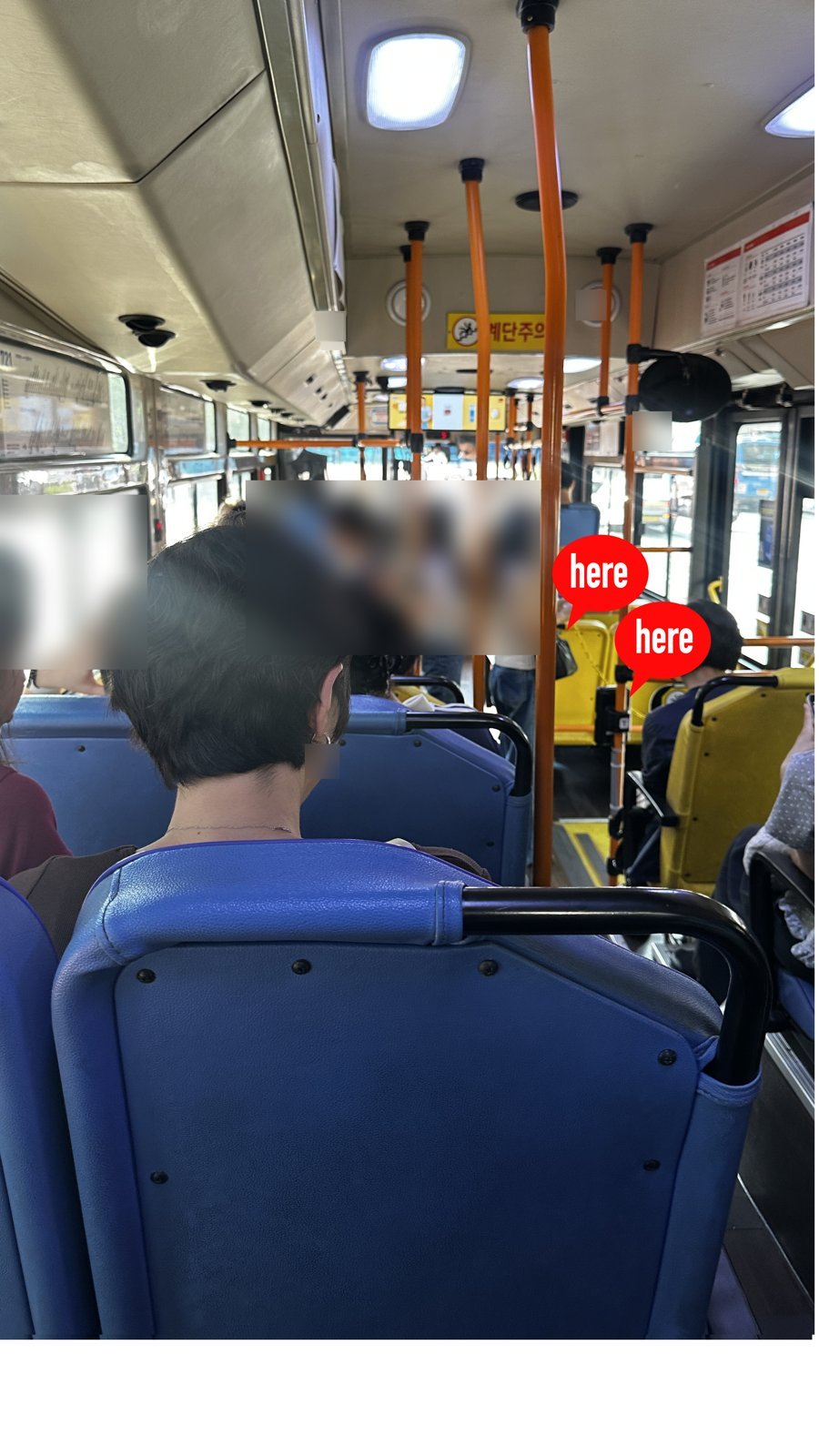
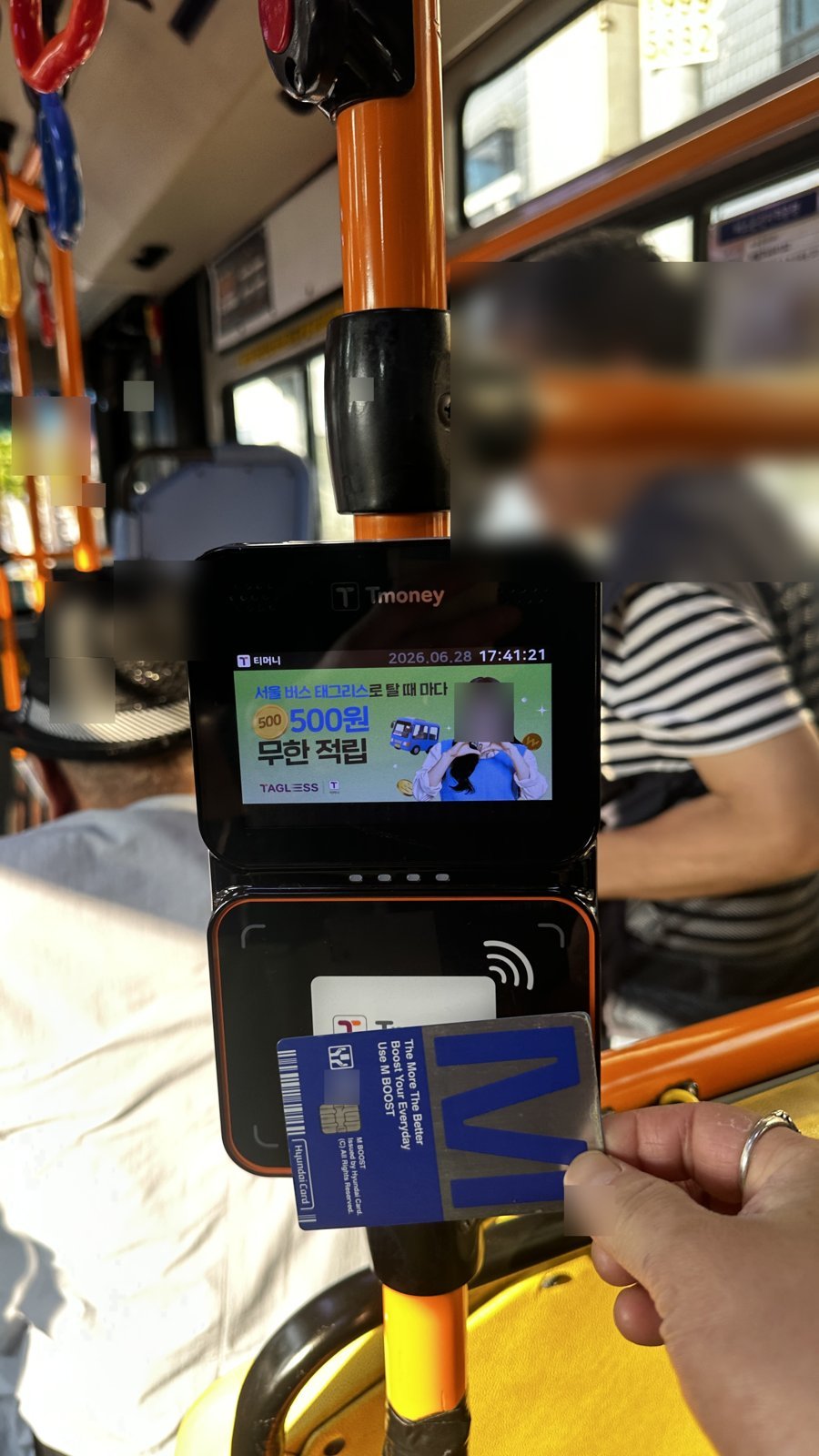
- Buses: tap when you board — and tap again on the reader by the back door when you get off. That second tap gives you free or cheap transfers to your next bus or the subway within about 30 minutes (an hour between 9pm and 7am), up to four transfers a day. Forget to tap off, though, and you can lose the transfer discount.
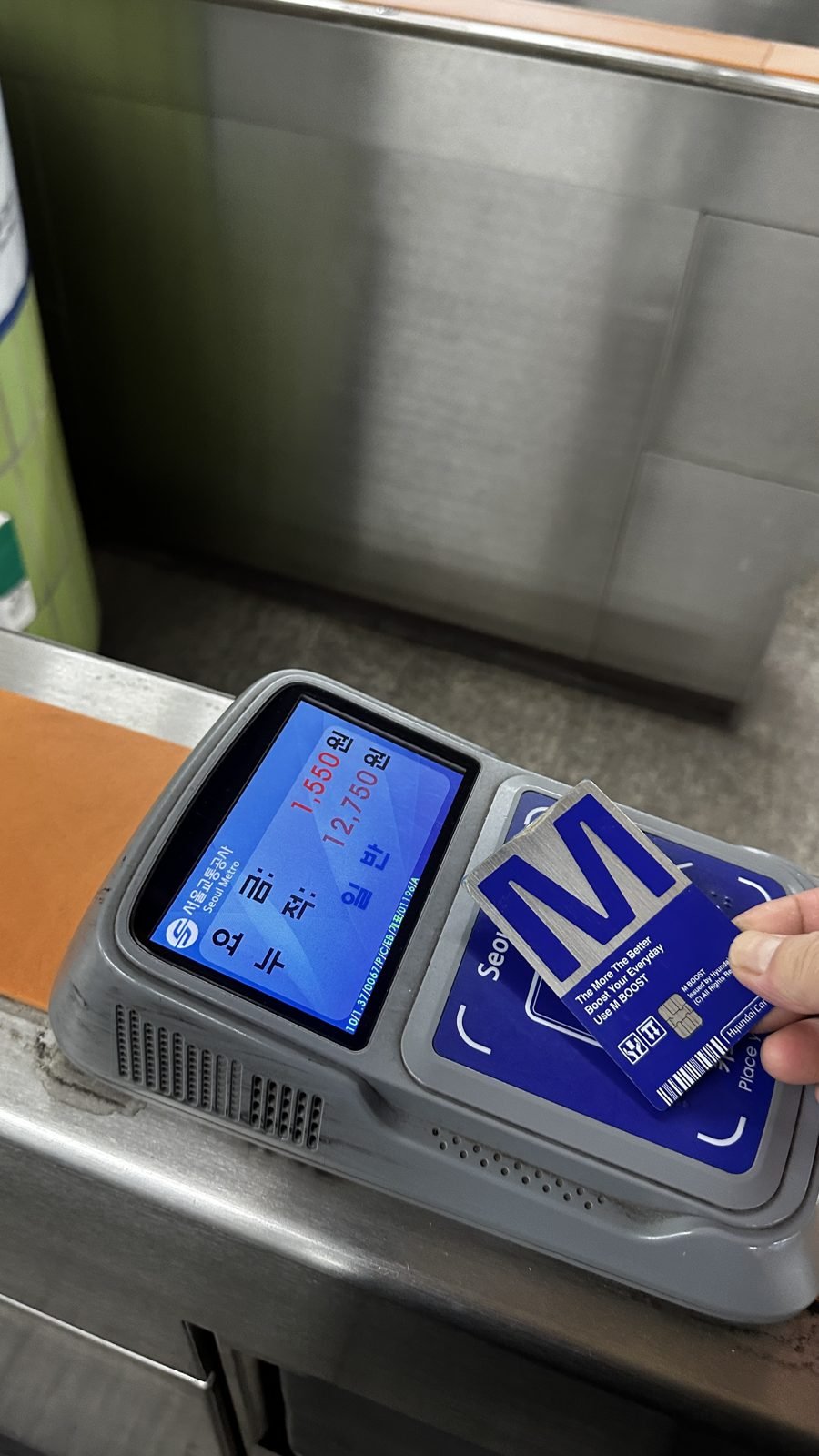
New for 2026: always tap out. Since March 2026, if you tap in with a T-money card but forget to tap out at the subway exit, the system adds an extra base fare to your next trip — about ₩1,550 for an adult (₩900 teen, ₩550 child). The gate won’t open without a tap anyway, so just make the exit tap a reflex. Single-journey tickets and travel passes are exempt.
One small mercy runs the other way: if your balance dips just below the fare, T-money still lets you through once and takes the shortfall off your next top-up. It only works for a single ride, though — recharge before the next one.
One card can also pay for friends: tap it and tell the driver (or press for the number of people), and it deducts multiple fares. Handy for couples and families.
One card per person — yes, even for a family
The instinct is to buy one card and pay for the whole family with it. Don’t — in Korea you really do need one card per person, for two reasons.
First, subway gates take one person per tap. You can’t wave a single card to send a family of four through the turnstiles; each person taps their own card in and out. Sharing simply isn’t possible underground.
Second, the transfer discount is tracked per card. Korea has a generous system where transfers between bus and subway (and bus to bus) are free or cheap — up to four transfers within about 30 minutes (an hour late at night), as long as you use the same card and remember to tap off when you leave a bus. That discount follows the card, so each traveler needs their own to keep their own transfer chain. (You can pay for several people with one card on a bus by telling the driver the number — but the transfer discount only holds if the whole group stays together to the same stop, and it collapses the moment anyone splits off. Simpler to carry one card each.)
Fares by age — and traveling with kids or grandparents
Fares depend on age, but a plain T-money card doesn’t know how old the rider is — it charges the adult fare for everyone until you register a birthdate. Here’s how it breaks down (T-money card fares in Seoul; cash is slightly more):
| Rider | Age | Subway | City bus |
|---|---|---|---|
| Adult | 19+ | ₩1,550 | ₩1,500 |
| Teen | 13–18 | ₩900 | ₩900 |
| Child | 6–12 | ₩550 | ₩550 |
| Under 6 | — | Free | Free |
| Senior (Korean resident) | 65+ | Free | Adult fare |
The kids’ discount — and how a tourist gets it. To pay the child or teen fare, you register the child’s birthdate on a T-money card. The easy way: buy a standard card at a convenience store and ask the staff to register it on the spot — you only need the child’s passport (for the birthdate), no Korean ID, phone, or bank account, and the discount applies immediately. (If you instead buy a blank card from a station machine and start riding, you must register the birthdate within 10 days or lose the discount — so the counter route is cleaner.) An unregistered card charges full adult fare, so this little step is what saves you roughly ₩1,000 a ride for a child.
Little ones under 6 ride free. Children who haven’t turned 6 yet pay nothing on buses or the subway — up to three of them per accompanying adult (a fourth pays the child fare). They need no card and no registration; they just travel with you. This works the same for foreign families as for Korean ones, since it’s based purely on age.
⚠️ It’s the 6th birthday that matters, not the birth year. As a rough snapshot, in June 2026 a free rider is a child born from about mid-2020 (around July 2020) onward — anyone who hasn’t reached their sixth birthday. The trap: go by the actual birthday, not the year. A child born in early 2020 who has already turned 6 this year must pay the child fare, even though they were “born in 2020.” Once your child’s 6th birthday passes, they start paying.
A small subway move for free kids. On a bus it’s easy — your little one just gets on with you. A subway gate is slightly trickier, because the child has no card to tap: put the child through the gate just ahead of you, then tap your own card right behind them and walk through together quickly. The gate only stays open for a moment, so don’t let a gap open up between you.
Grandparents, read this carefully. Korea’s famous “free subway for seniors” is a welfare benefit for Korean residents aged 65 and up (it’s 65, not 60), tied to Korean resident registration. A foreign tourist does not get it — a visiting 65-year-old pays the normal adult fare. It’s also subway-only; even Korean seniors pay full fare on buses. And don’t try to use a senior single-use ticket without eligibility — that’s treated as fare evasion, with steep penalties.
The simplest move for a family: if you’re all sightseeing actively, just buy everyone a flat-price Climate Card day pass — it’s the same price at every age, with no registration and no senior benefit to chase (it doesn’t apply to tourists anyway). If you’d rather pay per ride, register the kids’ T-money cards and treat the grandparents as adults.
Using T-money on an iPhone (it works, but mind the catches)
For years the rule was “iPhones can’t do Korean transit.” That changed in mid-2025 — you can now put T-money in Apple Wallet and ride with a tap (no Face ID needed, on iPhone XS / iOS 17.2 or newer). The good news: you do not need a Korean Apple ID. But there are real catches, so here’s the honest version.
Add it the right way. Don’t use Apple Wallet’s own “Add Transit Card” button — that flow demands a Korean Hyundai Card to set up, which most tourists don’t have. Instead, install the free Mobile Tmoney app (it’s on the US, UK, and other App Stores, not just Korea’s), open it, tap “Browsing” (둘러보기) to skip the sign-up and Korean-phone verification, and choose “Add to Apple Wallet.” If you see a “region settings prevent Apple Pay” message, go to Settings → General → Language & Region, switch the region off and back to South Korea, and try again.
Topping it up is the harder part. You cannot load the card with a foreign card from inside Apple Wallet (a promised foreign-card top-up was scrapped in early 2026). Your only options are cash at a subway-station kiosk, or the Mobile Tmoney app with a Mastercard, Amex, or UnionPay (around a 4–5% fee — Visa doesn’t work, and even the supported cards can be flaky).
Honest bottom line: it’s handy when it cooperates, but it’s fiddly, and plenty of travelers decide it’s more trouble than it’s worth. If you’d rather not gamble, just buy a physical T-money card at any convenience store, or get a WOWPASS — both are more reliable for a short trip. (One more quirk: even once set up, the Apple Wallet card can be hit-or-miss at convenience-store checkout terminals, so keep another way to pay for shopping.)
Don’t fancy a card? The single-journey ticket
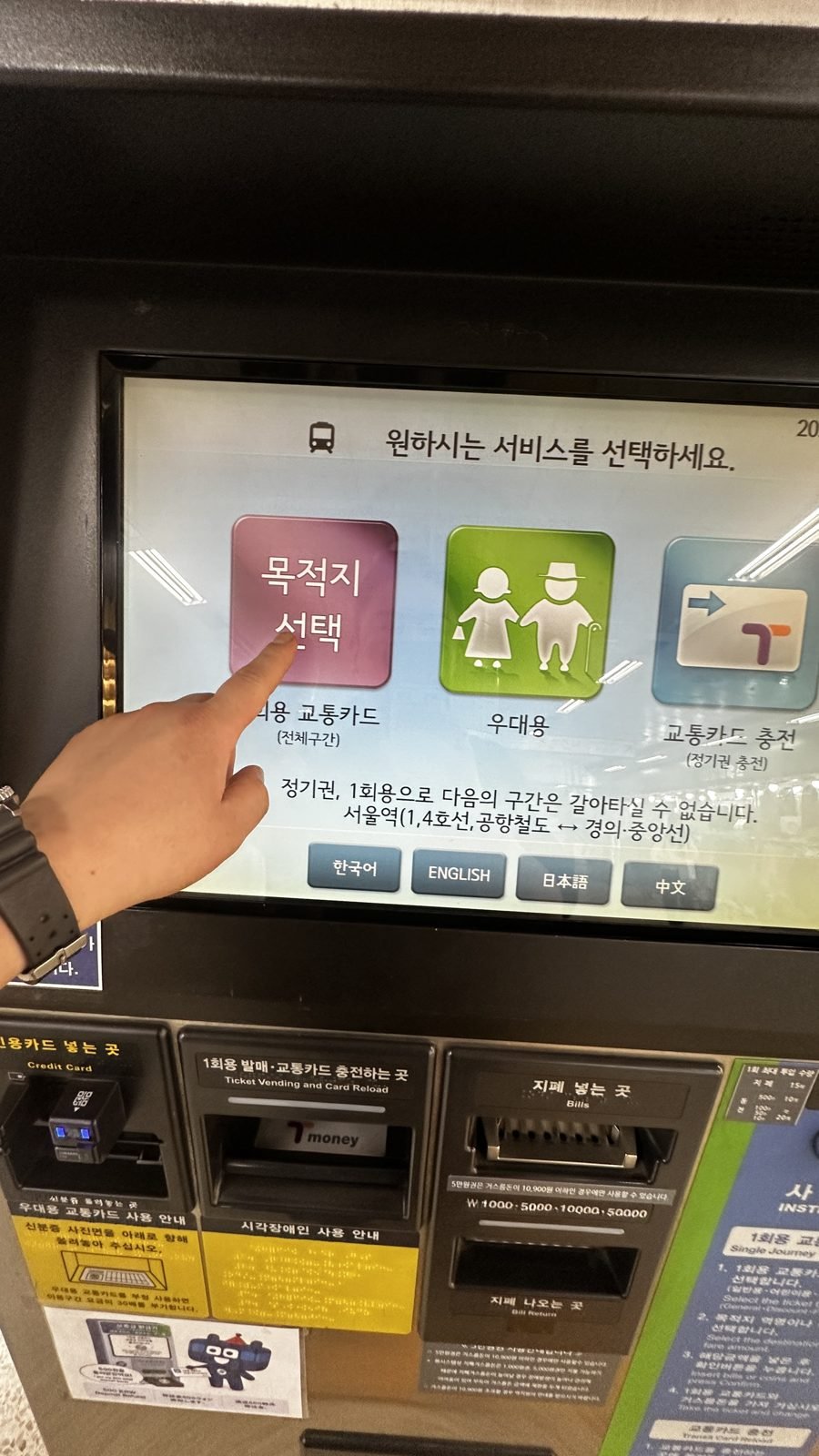
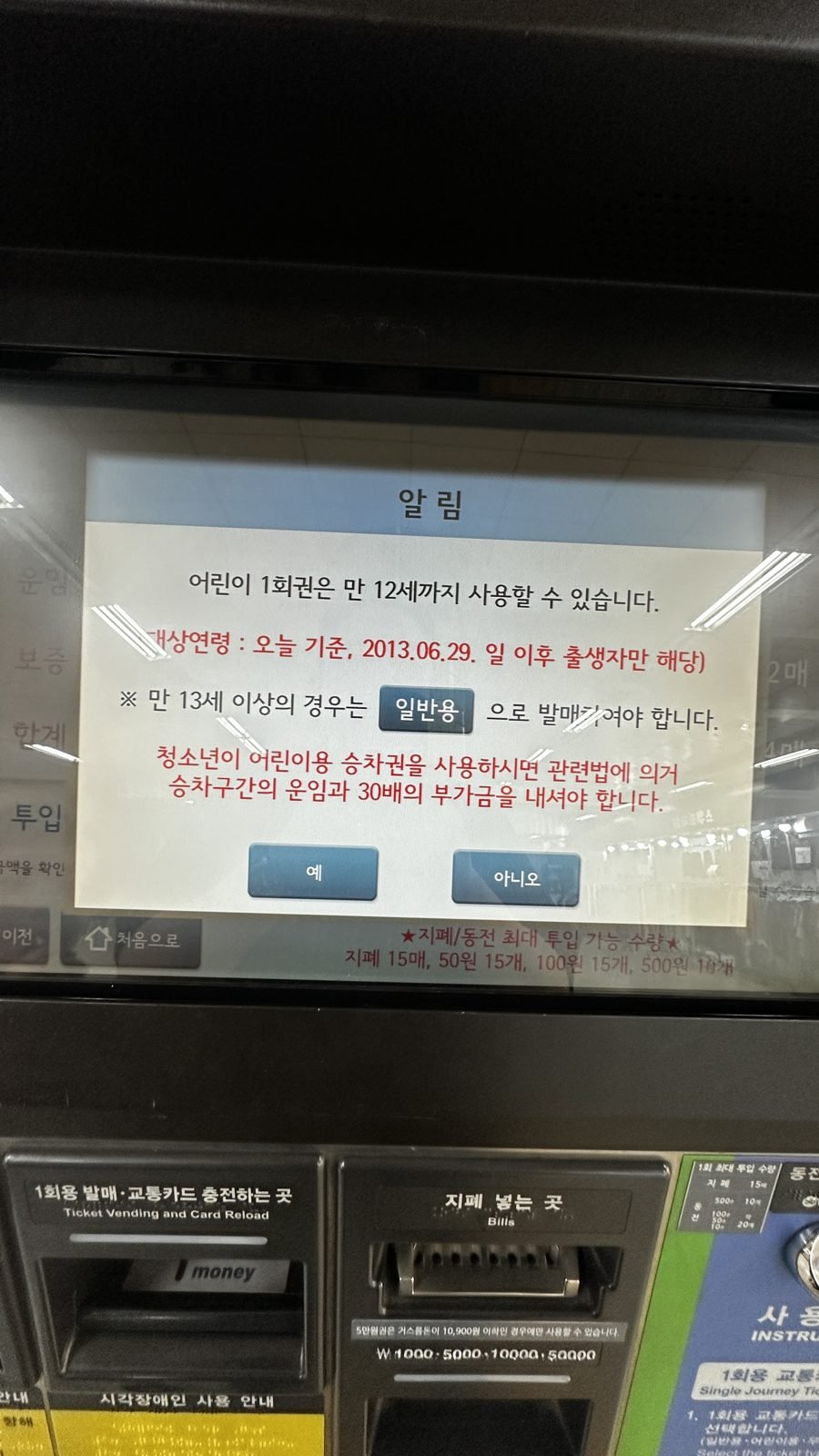
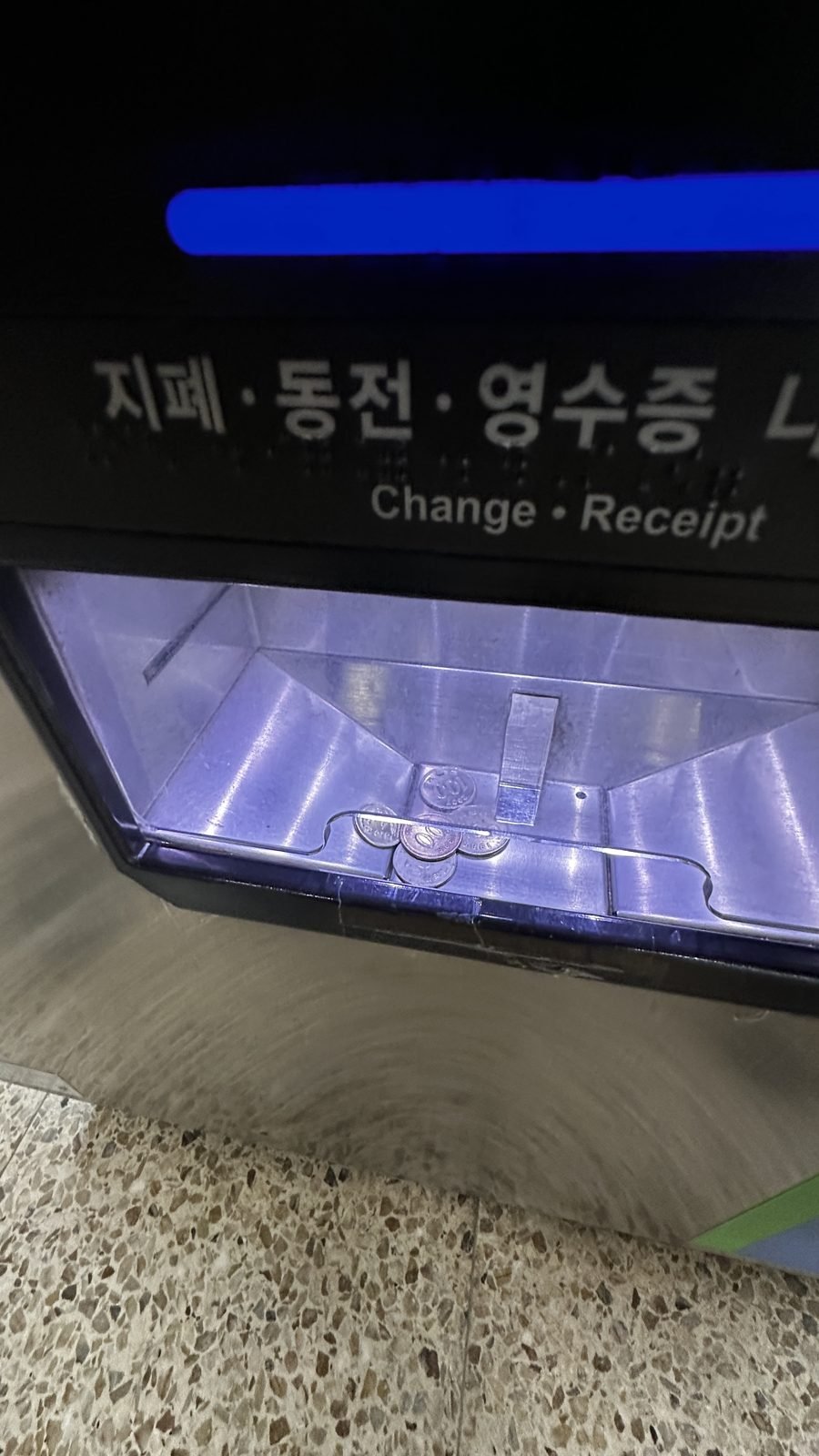
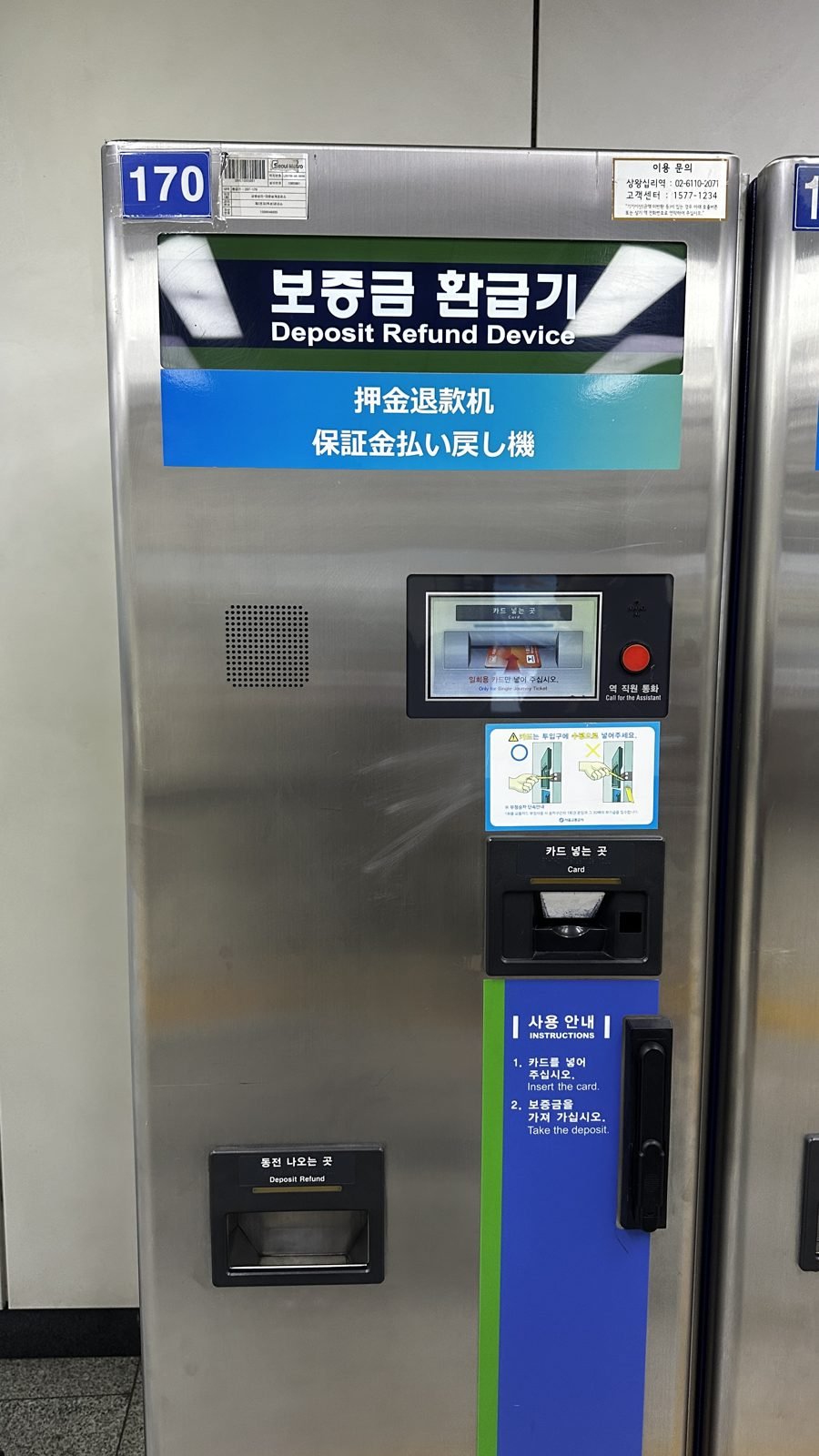
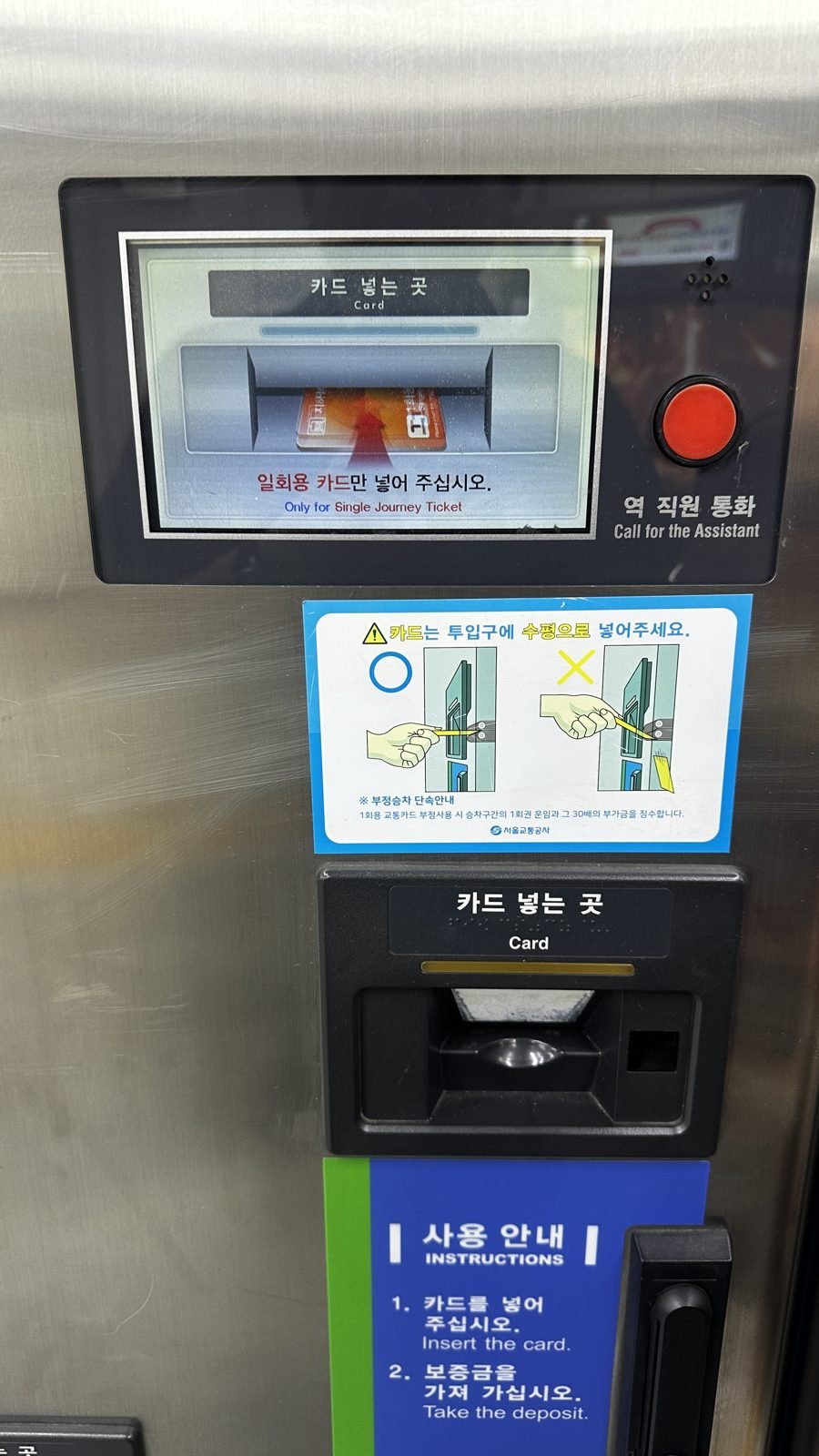
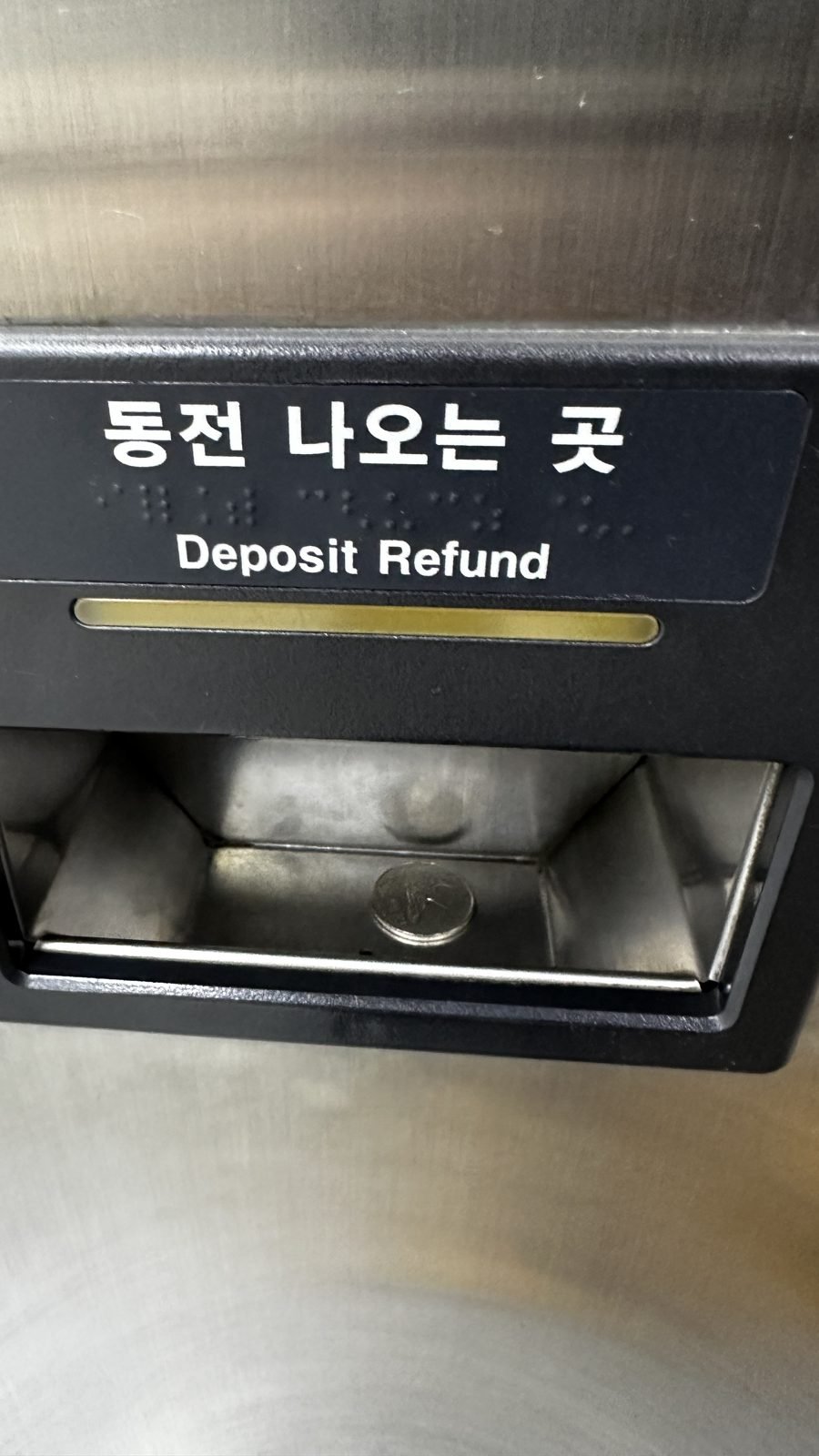
If you’re only making a hop or two and don’t want a rechargeable card, you can buy a single-journey ticket at the same station machines. Pick your destination on the screen, pay in cash, and out slides a slim yellow card — the fare plus a refundable ₩500 deposit.
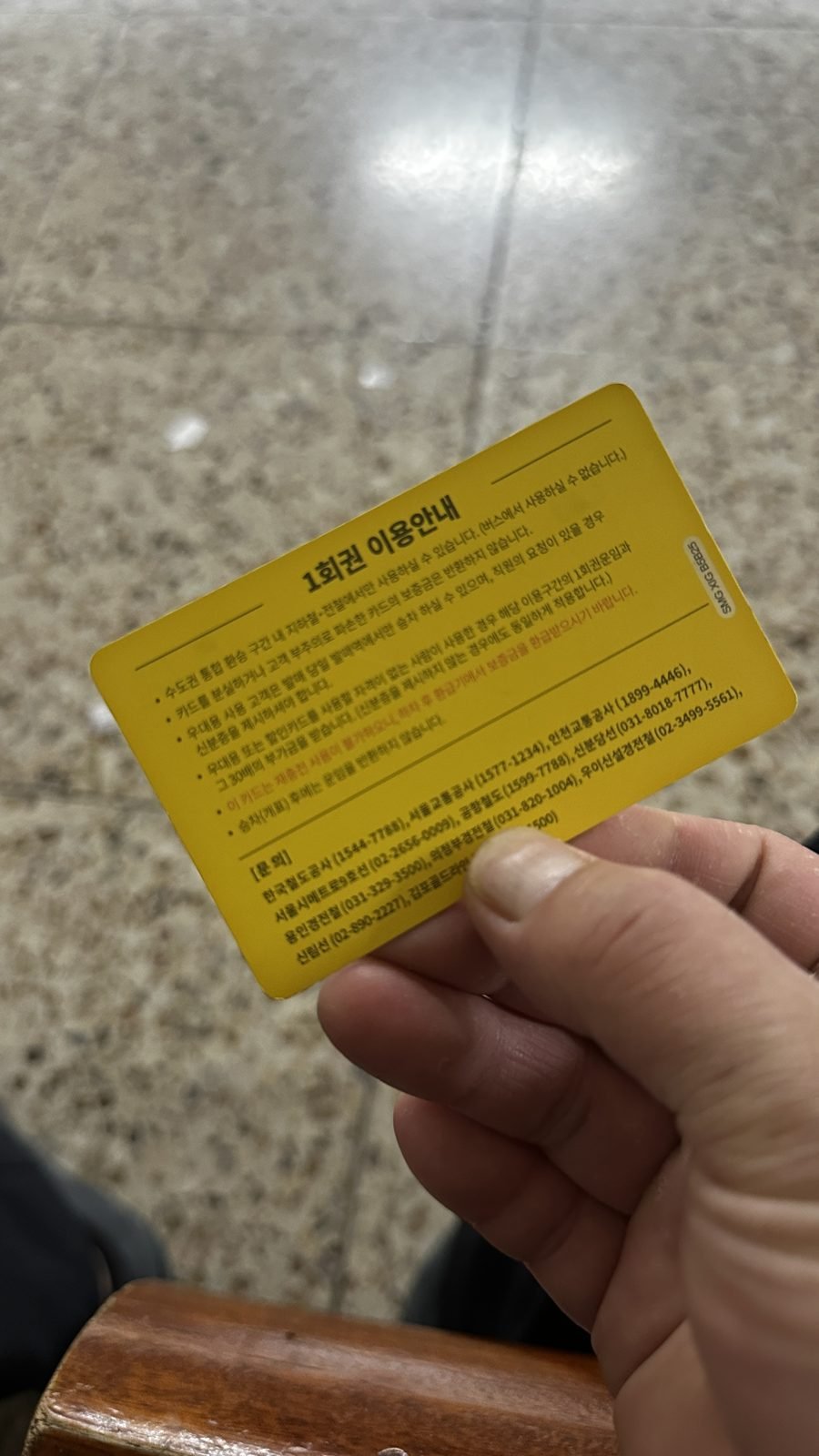
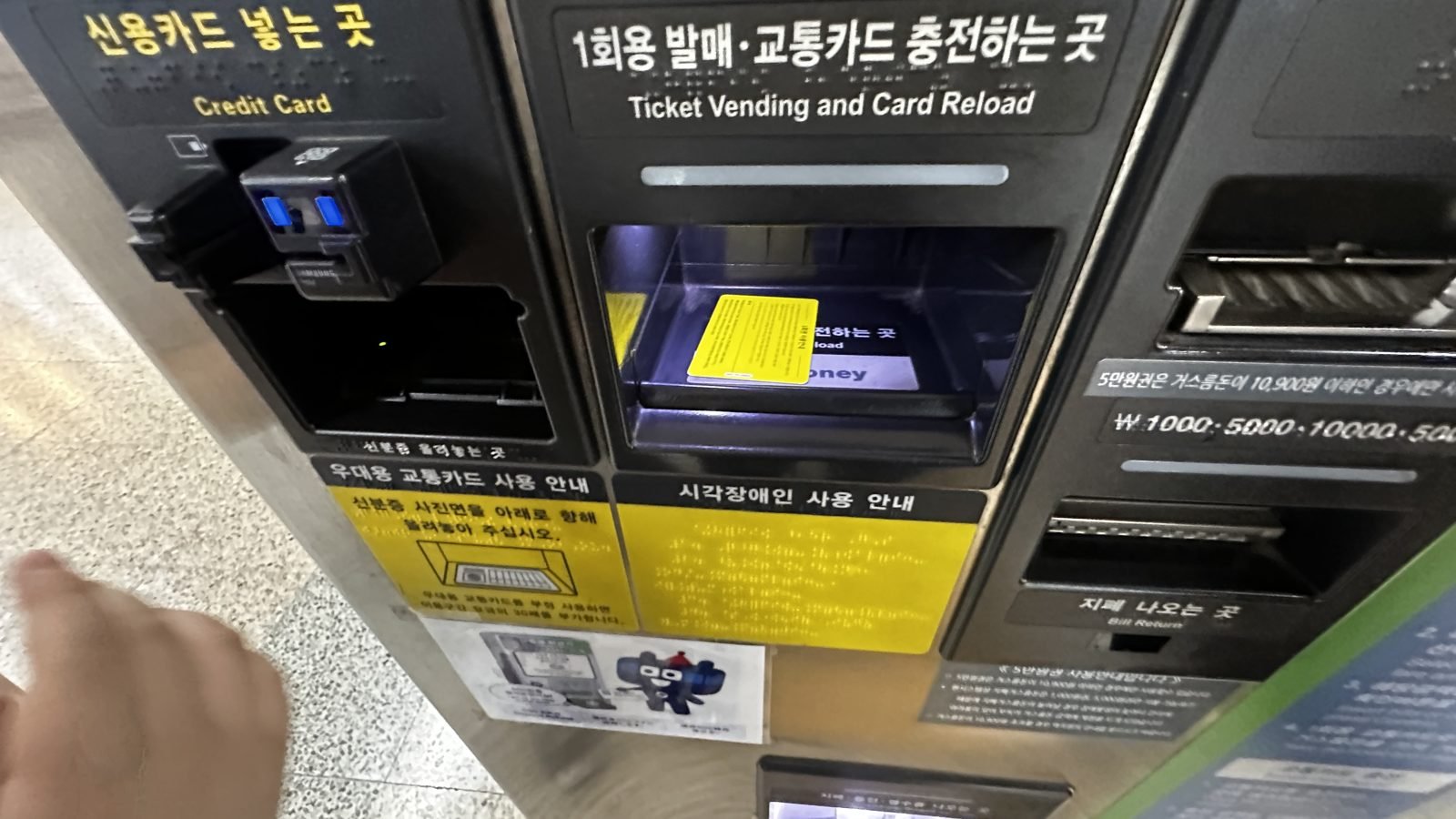
Tap it at the gate like any other card. Then on your way out, feed the used card into a Deposit Refund machine near the gates and your ₩500 drops straight back out. It’s more fuss than simply tapping a T-money card, so it really only makes sense for a single short ride. (One quirk in its favor: a single-journey ticket is exempt from the subway tap-out penalty that now applies to T-money cards.)
Which T-money card or pass should you get?
T-money comes in a few versions, and there are a couple of passes worth knowing. Here’s how to choose:
- Tmoney Travel Card (₩4,000): the tourist version of the basic card. It works exactly like regular T-money — nationwide buses, subway, taxis, and convenience stores — and adds small partner discounts at some tourist spots and shops. Sold at convenience stores and the staffed bus-ticket desks at Incheon Airport. For most travelers, this is the simple default. (The old “Korea Tour Card” has been discontinued and folded into this.)
- Tmoney Travel Card + (₩6,000): the same Travel Card combined with WOWPASS. On top of transit, it works as a foreign-currency spending card at Korean IC terminals (including shops that don’t take foreign cards), and you reload or withdraw cash through WOWPASS kiosks and app. Worth the extra ₩2,000 if you want one card for both riding and spending.
- Climate Card (기후동행카드): unlimited Seoul transit for a flat price — 1-day ₩5,000 up to 7-day ₩20,000. If you’re staying in Seoul and riding a lot, this is the cheapest option. Seoul-only, and on iPhone it’s a physical card.
- Seoul Metropolitan M-PASS (수도권 M-PASS): a pass good for up to 20 rides a day on the metro, Seoul city buses, and the airport railroad (regular, non-express trains). Prices run from 1-day ₩15,000 (₩12,000 if you buy after 5 p.m.) up to 7-day ₩64,500, including a ₩5,000 card deposit you mostly get back. The catch: it’s only sold and returned at one spot — T-money Town by Seoul Station (Exit 10), weekdays 9 a.m.–6 p.m. — and it’s far pricier than the Climate Card. It mainly pays off if you’ll lean on the airport railroad or ride very heavily.
- WOWPASS / Cashbee: WOWPASS is the all-in-one spending-plus-transit card (also bundled as the Travel Card +). Cashbee is the equivalent rival transit card — fine if you end up with one.
For most first-timers: grab a Tmoney Travel Card for simplicity, add a Climate Card if you’ll ride all over Seoul, or step up to the Travel Card + if you want spending built in.
Getting your money back before you leave
You can refund the leftover balance — but never the card price (that’s a purchase, not a deposit). Where you go depends on how much is left:
- Small amounts — at a convenience store for a ₩500 fee: up to about ₩20,000 at GS25/7-Eleven, or ₩30,000 at CU/Emart24.
- Up to ₩50,000 — at a subway station service center (₩500 fee).
- Larger amounts — at T-money Town by Seoul Station (Exit 10), up to ₩500,000 with no fee. The catch: anything ₩100,000 or more is not paid in cash — it’s wired to a Korean bank account the next business day. With no Korean account, a tourist effectively can’t get a big balance back in cash.
⚠️ There’s no refund counter past airport security. At Incheon you can only refund landside, before security (convenience stores, or the Airport Railroad desk on B1F up to ₩50,000); once you’re through, the balance is stranded.
So the rule is simple: don’t over-charge the card. Top up in small amounts (₩5,000–10,000) toward the end of your trip, and spend the rest — T-money buys snacks, coffee, and taxi rides — before you head to the airport. If you do end up with a big balance, refund it before airport security, in chunks under ₩100,000 if you want cash.
The Apple Pay myth, busted
You may have read headlines like “Apple Pay / Mastercard now works on the Seoul subway.” Be careful — that’s misleading. What those headlines really describe is putting T-money itself into Apple Wallet (set up via the Mobile Tmoney app, as covered above) and tapping that. The gate still reads your T-money balance, never your bank card. You cannot tap a foreign Visa, Mastercard, or foreign Apple Pay directly on a Seoul gate to ride.
The one place open-loop tap-to-ride genuinely works today is Jeju Island city buses, which since 2025 accept a Visa card (physical or in your phone). Everywhere else — Seoul, Busan, Incheon, the airport train — it’s T-money. Seoul plans to add foreign-card tapping in phases (buses, then subway gates around 2027, full rollout by 2030), but it isn’t available to riders yet.
FAQ
Can I use my foreign credit card to tap into the Seoul subway?
No. Korean gates read T-money, not foreign contactless cards. Get a T-money or Climate Card. (The only exception today is Jeju Island buses, Visa only.)
Can I recharge T-money with my foreign card?
Not for a physical card — that’s cash only, so carry Korean won. (An iPhone’s Apple Wallet card can be topped up in the Mobile Tmoney app with a Mastercard or Amex — not Visa — but it’s fiddly.)
Do I need to register T-money or download an app?
No. A physical card is anonymous and works straight out of the package. The app only comes in if you want to add T-money to an iPhone’s Apple Wallet (and that’s fiddly — see the iPhone section above).
Is T-money or the Climate Card better?
Climate Card if you’re staying in Seoul and riding a lot (unlimited, cheap day passes). Plain T-money if you’re traveling between cities, since it works nationwide.
Where do I get my leftover balance back?
At a convenience store (₩500 fee) or subway service center — but not at the airport, so do it before you head out.
Do kids and seniors pay less?
Kids do — register a child’s birthdate on a T-money card (passport only) for the child (6–12) or teen (13–18) fare. Korea’s free senior subway is for Korean residents 65+, so foreign senior tourists pay the adult fare.
Can my family share one T-money card?
No. Subway gates take one person per tap, and the transfer discount is tracked per card — so everyone needs their own card to pass the gates and keep their own free transfers.
Does T-money work outside Seoul?
Yes — it’s nationwide. One card works on the subways in Seoul, Busan, Daegu, Daejeon, Gwangju and Incheon, and on city and rural buses across the country, including Jeju. Just keep some cash for ferries, trains, intercity buses, and a few very remote cash-only routes.
Where this card takes you
T-money in hand, the rest of the trip is tap-and-go: from the airport into Seoul, back out again from Hongdae, a Kakao T taxi when the subway closes, the bus out to Everland or Lotte World, and a food run through Gwangjang Market.